
Quick Answer, Best Time to Trade Futures
- The best window for equity index futures (ES, NQ, RTY) is 9:30-11:00 AM ET at the New York cash open.
- Crude oil (CL) trades best from 9:00-10:30 AM ET, with Wednesday at 10:30 AM the highest-activity print of the week.
- Gold (GC) peaks during the London-New York overlap, 8:00-11:00 AM ET.
- Avoid 12:00-2:00 PM ET: volume drops 50-70%, spreads widen, and chop eats prop accounts alive.
- Most prop firms require positions flat by 4:00-5:00 PM ET, so overnight holds aren't an option anyway.
---
The Three Major Futures Sessions
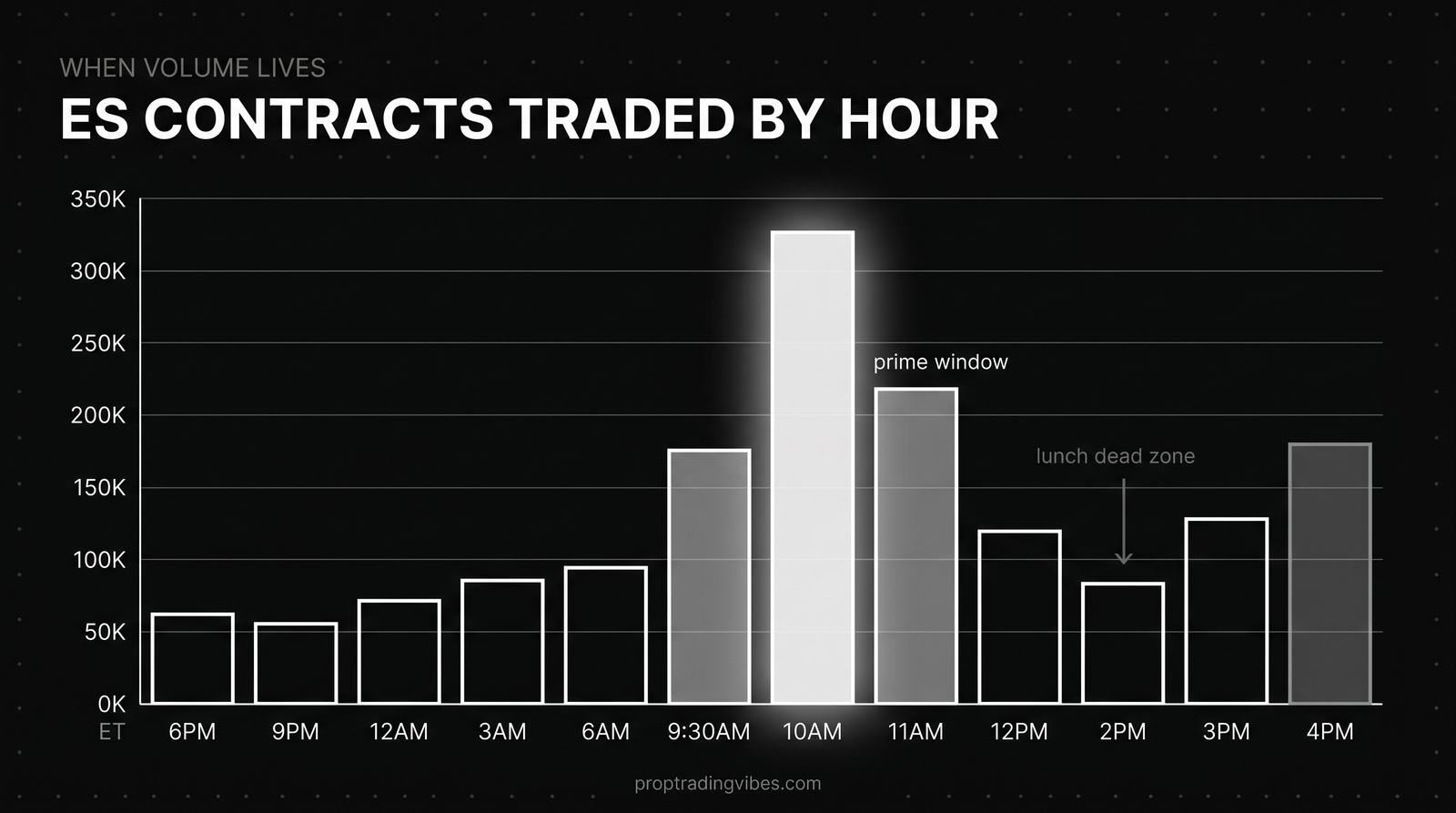
Futures on CME Globex run nearly 24 hours: Sunday 6:00 PM ET through Friday 5:00 PM ET, with a 60-minute maintenance break daily at 5:00 PM ET. But continuous uptime doesn't mean continuous opportunity. Three distinct sessions drive the market, and they perform very differently depending on the product.
Asian Session (6:00 PM - 2:00 AM ET)
The Asian session opens with the CME Globex restart at 6:00 PM ET each evening. For equity index futures, it's mostly a dead zone. ES might trade 50,000-100,000 contracts per hour overnight versus 300,000+ during the New York open. Moves look significant on a chart because the scale is the same, but they're driven by thin order books and can reverse on nothing.
Gold (GC) and currency futures (6E, 6J) are different. Asian central bank activity and regional economic releases create genuine flow in those products. If you trade gold or yen futures and your prop firm allows overnight positions, the Asian session has merit. For equity index traders, it doesn't.
London Session (3:00 AM - 12:00 PM ET)
Volume picks up noticeably around 3:00-4:00 AM ET when European institutions come online. By the time New York opens, the London session has often established 60-70% of the day's range on ES and NQ. That pre-market range is important information: it tells you what levels the market has already tested and where New York will find resistance or support.
Gold is heavily influenced by London. The city is the world's largest physical gold trading hub, and GC volume spikes during London morning hours. Crude oil also sees real London session activity tied to European energy demand and Brent pricing.
For equity index futures, London creates the context but New York makes the market.
New York Session (8:00 AM - 5:00 PM ET)
This is where the bulk of futures volume lives. The pre-market window from 8:00-9:30 AM ET carries economic data releases (CPI, PPI, jobless claims, GDP). These releases move the market before the cash open and set the tone for the day.
The 9:30 AM ET cash open is the single highest-volume moment of the trading day across ES, NQ, RTY, and YM. The first 30 minutes alone routinely produces more volume than the entire Asian session. That's not hyperbole: 300,000+ contracts in the first 15 minutes of the New York open is normal for ES.
Two hours of focused New York morning trading beats eight hours spread across lower-quality sessions. See the CME trading hours breakdown for exact Globex open/close times by product.
---
Best Trading Windows by Product
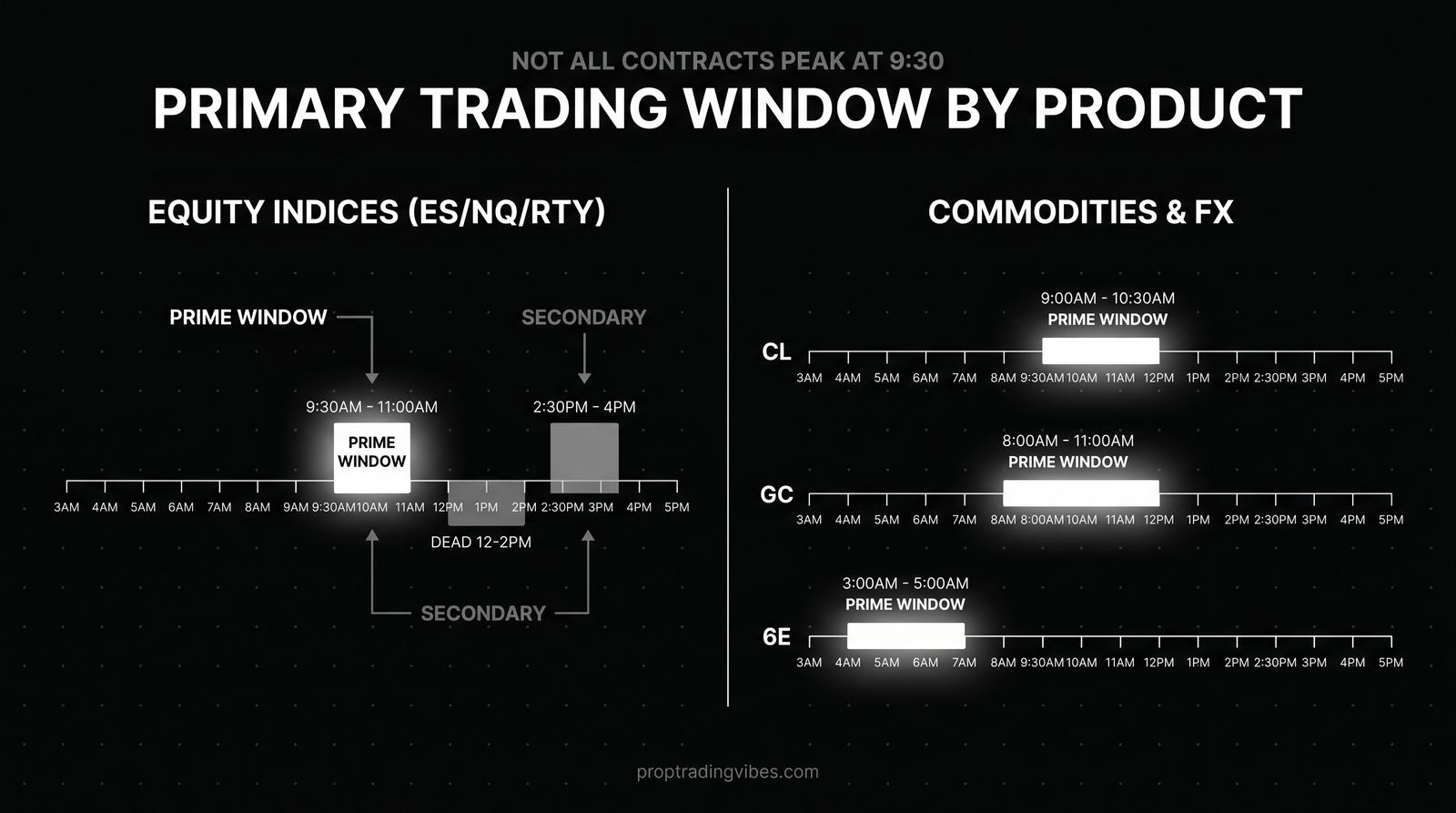
Same contract, different market depending on the hour. Here's the data by product:
| Product | Primary Window | Secondary Window | Avoid | Peak Note |
|---|---|---|---|---|
| ES (S&P 500) | 9:30-11:00 AM ET | 2:30-4:00 PM ET | 12:00-2:00 PM ET | Cash open drives 30%+ of daily volume |
| NQ (Nasdaq-100) | 9:30-11:00 AM ET | 2:30-4:00 PM ET | 12:00-2:00 PM ET | Higher per-point volatility than ES |
| CL (Crude Oil) | 9:00-10:30 AM ET | 3:00-5:00 AM ET | 12:00-1:00 PM ET | Wed EIA report at 10:30 AM = weekly spike |
| GC (Gold) | 8:00-11:00 AM ET | 3:00-5:00 AM ET | 1:00-5:00 PM ET | London-NY overlap is the prime window |
| RTY (Russell 2000) | 9:30-11:00 AM ET | 3:00-4:00 PM ET | 12:00-2:30 PM ET | Thinner than ES/NQ, wider spreads off-hours |
| 6E (Euro FX) | 3:00-5:00 AM ET | 8:00-10:00 AM ET | 2:00-6:00 PM ET | European economic data drives flow |
Why the 9:30 AM Open Matters
Three things converge at 9:30 AM that don't happen at any other time:
- Volume surge. Institutional order flow hits all at once. ES can trade 40,000-60,000 contracts in the first 15 minutes.
- Directional conviction. The opening 30-60 minutes usually resolves whether it's a trend day or a range day. A gap held above the opening range for 30 minutes sharply increases trend-continuation probability.
- Data catalysts. Most major economic releases print between 8:30-10:00 AM ET. The 30-60 minutes after the release is when the market digests the data and commits to a direction.
For a full breakdown of when each futures contract opens and closes, the futures market hours guide has the complete schedule.
---
Hours to Avoid
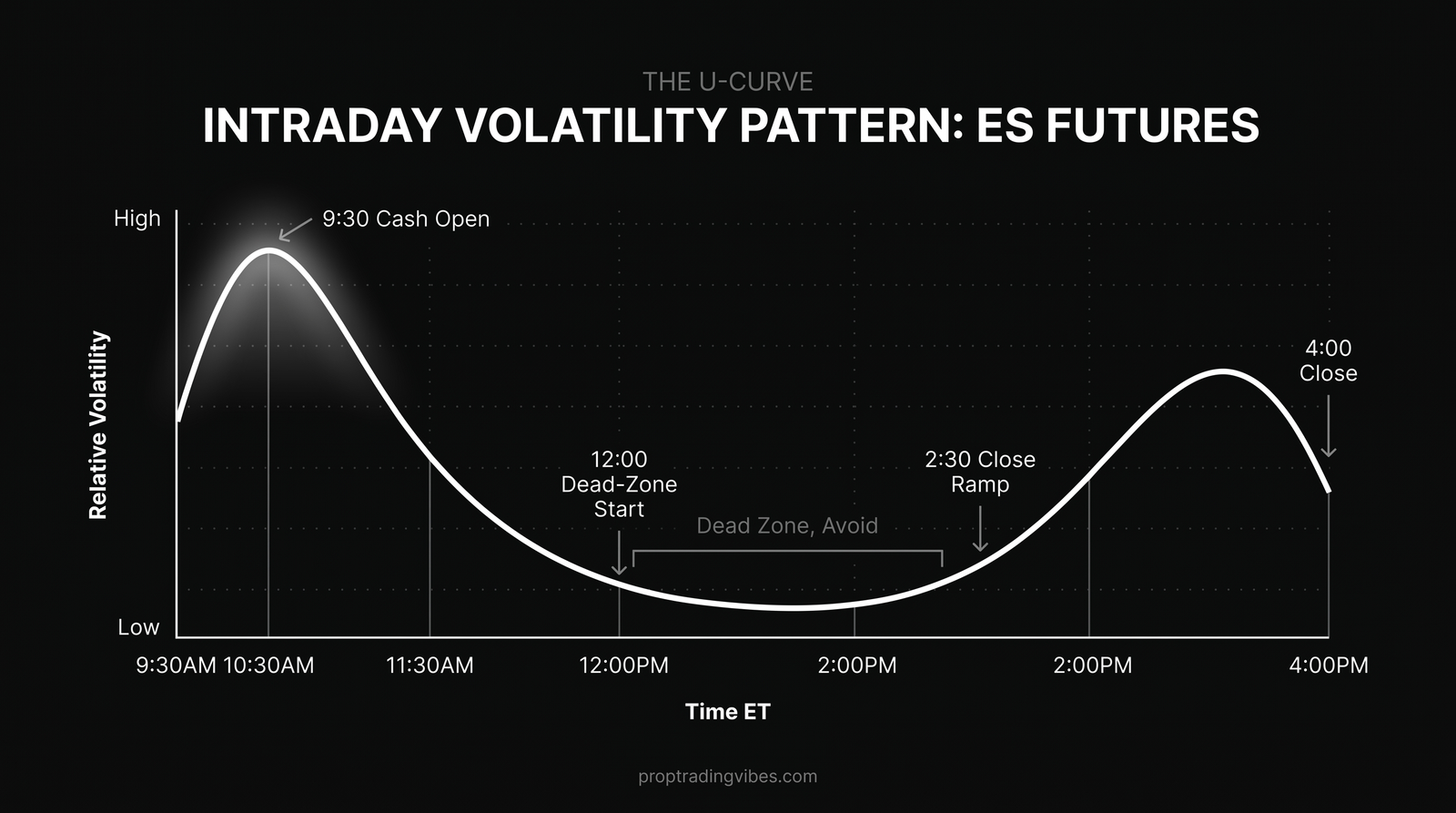
Some windows don't just produce fewer opportunities. They actively work against you.
The Lunch Dead Zone (12:00 - 2:00 PM ET)
Volume on ES drops 50-70% compared to the morning. Spreads widen. Price action chops in a narrow range, produces false breakouts, and reverses on nothing. The order book is thin, which means a single large order can spike price 3-5 points and immediately snap back.
Win rates tracked over time typically fall 15-20 percentage points during lunch compared to the morning session. Average winners shrink and average losers grow. Lunch-hour trading is a net negative for most prop traders, not because the setups look bad, but because the market structure underneath them is broken.
Stop at 11:00-11:30 AM. Reopen at 2:30 PM if you want the afternoon close.
Overnight Asian Hours for Equity Indices (6:00 PM - 3:00 AM ET)
ES can move 20 points overnight on volume that represents less than one minute of New York open activity. Those moves look real on a chart. They're not reliable. Thin liquidity means a single large order, a news headline, or even a thin bid stack can move price significantly with no follow-through.
Unless you're specifically trading gold or currency futures, the overnight session isn't worth monitoring, let alone trading.
The Final 30 Minutes Before Close (3:30 - 4:00 PM ET)
Market-on-close (MOC) institutional orders hit in the final 30 minutes, which creates a volume spike. The price action is erratic: MOC orders can push ES 5-10 points in one direction before snapping back as the orders fill. For prop traders with a 4:00 PM ET flat requirement, opening a position at 3:50 PM gives you 10 minutes to exit. That's not enough runway on a drawdown-limited account.
Stop opening positions by 3:00 PM ET and focus on managing or closing anything still open.
---
Economic Events and Your Trading Schedule
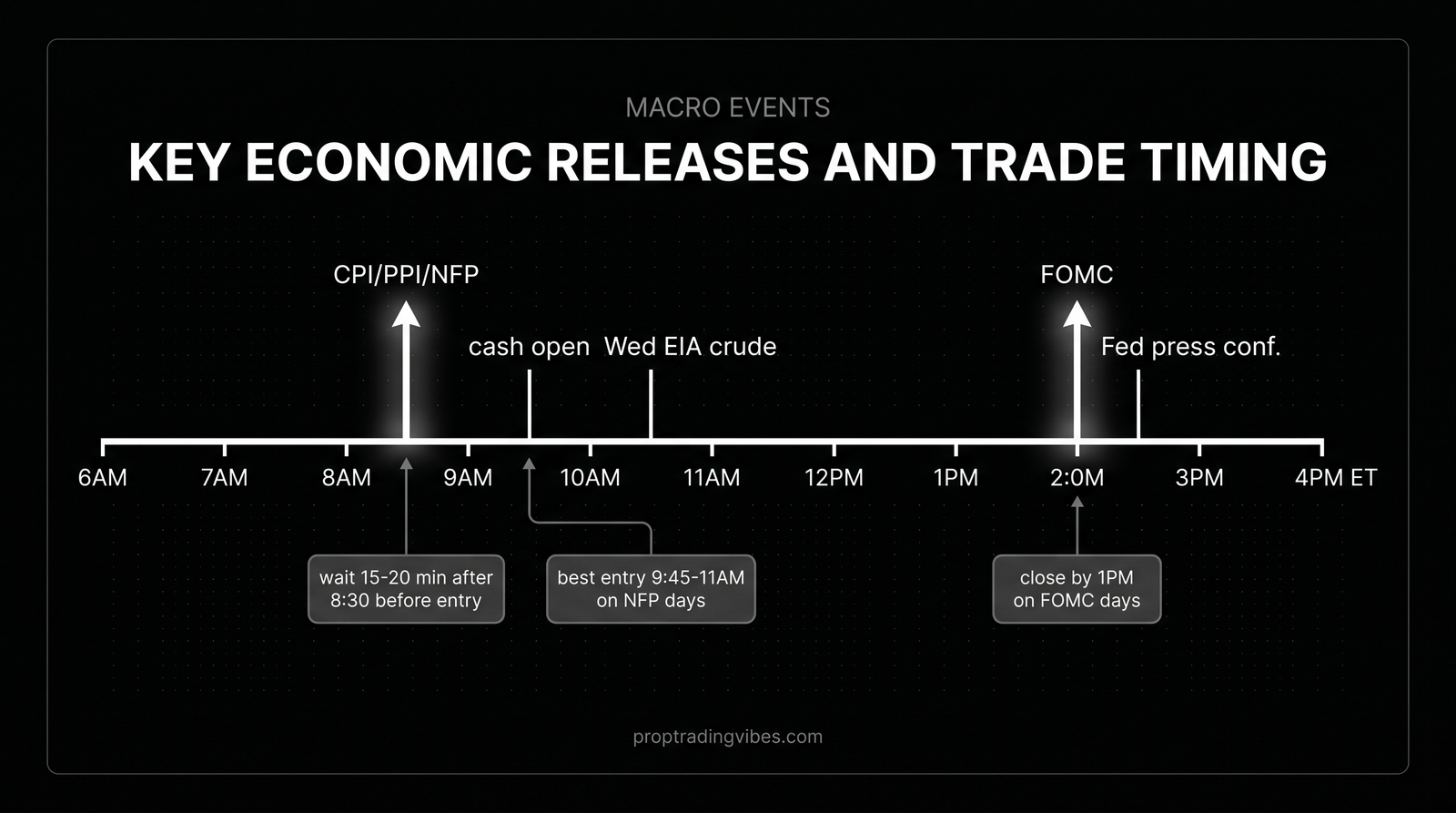
Major releases don't just move the market. They change when you should trade on those specific days.
FOMC Announcement Days
The Fed announces rate decisions at 2:00 PM ET with a press conference at 2:30 PM. The morning session on FOMC days runs quieter than normal: traders hold back waiting for the decision, so volume is suppressed. Then 2:00 PM hits and ES can swing 50-80 points in rapid, multi-directional moves.
The practical approach: trade the morning session normally, close everything by 1:00 PM, and don't trade the announcement. FOMC reactions have wide spreads and are non-directional until they settle 30+ minutes later. The risk-reward on a prop account during those swings is negative.
Some firms, including Apex Trader Funding, restrict news trading entirely, which makes this decision for you.
CPI and PPI Days (8:30 AM ET)
The 8:30-9:30 AM window on CPI days is genuinely dangerous. ES can gap 30 points on a surprise reading and then spend the next 30 minutes retracing. The initial move is often a knee-jerk that partially or fully reverses before the real direction is established.
Wait 15-20 minutes after the 8:30 AM print before taking positions. Let the market absorb the data and commit to a direction, then trade the follow-through.
Non-Farm Payrolls (First Friday, 8:30 AM ET)
Similar dynamic to CPI. The spike is unreliable; the trend that develops in the 9:45-11:00 AM window after NFP tends to carry through the session. On NFP Fridays, skip the first 15 minutes of the cash open and trade the 9:45 AM entry instead. You miss some potential, but you stay out of the worst whipsaw zone.
---
How Prop Firm Rules Shape Session Selection
Prop trading rules constrain your schedule, and those constraints are actually useful if you work with them rather than around them.
Flat-by-Close Requirements
Most firms require no open positions at market close: typically 4:00 PM ET for equity indices, though some use 4:15 PM or 5:00 PM. This eliminates overnight holds, which removes one category of risk entirely. For micro futures trading on small accounts, the overnight gap risk on a drawdown-limited account is usually not worth it anyway.
Stop opening new trades by 3:00 PM ET. Use the final hour to manage and close existing positions cleanly.
Trading Hour Restrictions
Some firms define specific trading hours. Check your firm's terms before trading any non-standard session. MyFundedFutures, TradeDay, and Bulenox all publish their permitted trading windows in their rules documentation.
News Event Restrictions
Several firms prohibit trading within 2-5 minutes of major economic releases. Even where it's allowed, the risk on a drawdown-limited account during FOMC or CPI prints is asymmetric in the wrong direction. Spreads blow out, slippage can exceed your stop, and a single whipsaw can consume multiple days of gains.
Consistency Requirements
Some firms require a minimum number of trading days per week or month. This prevents the strategy of "I'll only trade on FOMC days for the volatility." You need a repeatable daily window that delivers opportunities on normal market days. The 9:30-11:00 AM ET session does that consistently, five days a week, regardless of the macro calendar.
Firms like Lucid Trading and Take Profit Trader that enforce clean daily close rules reinforce the discipline of session-based trading rather than letting you drift into the lunch chop.
---
Day-of-Week Patterns
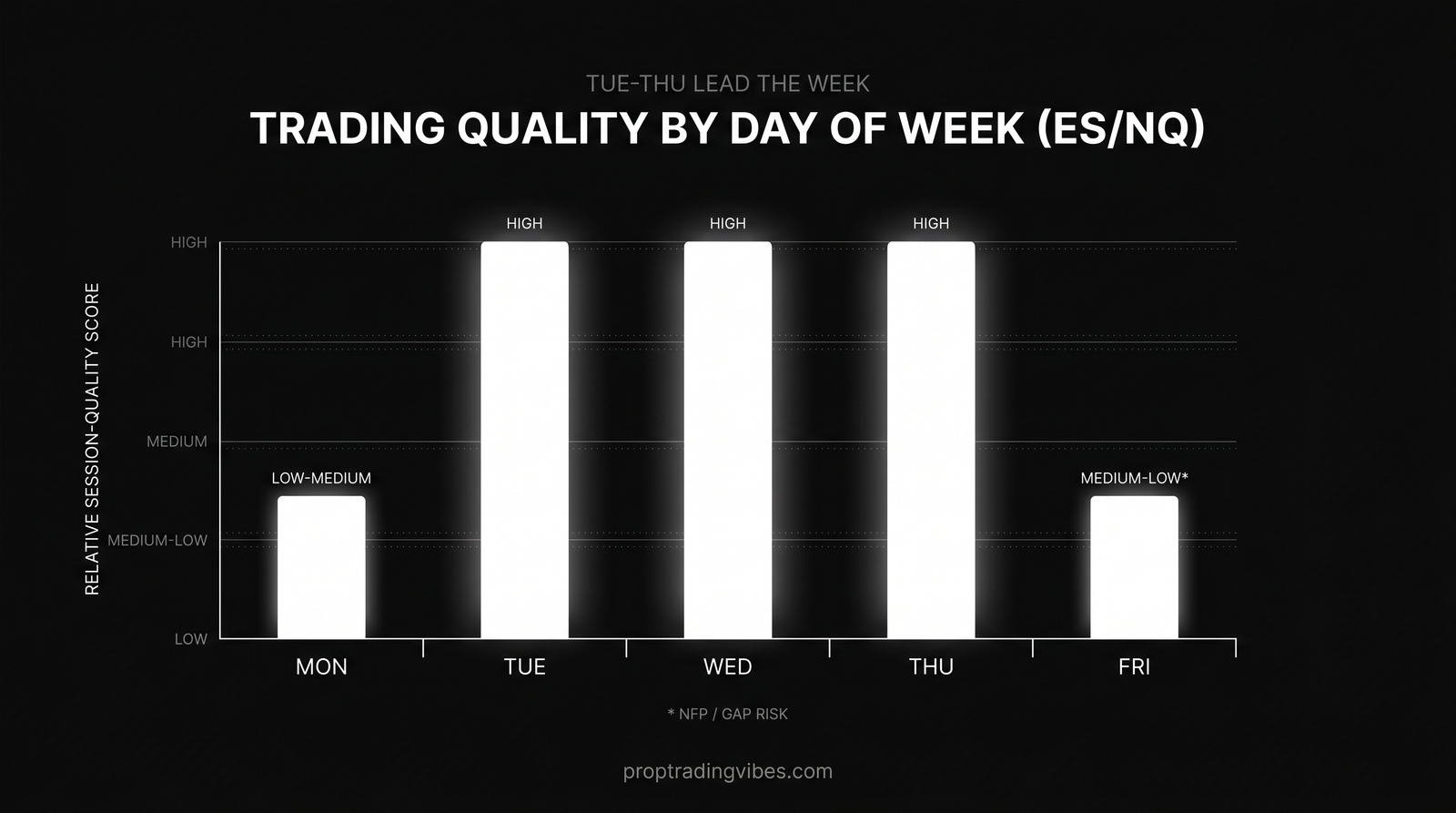
Real patterns exist. They're worth knowing, though they shouldn't override your read on the day itself.
Monday: Lowest average volume of the week. The market is absorbing weekend news and establishing the week's range. Trade lighter, wait for the 10:00 AM range to resolve before committing to direction.
Tuesday-Thursday: The core of the week. Highest average volume, most economic data releases, clearest price action. Tuesday and Wednesday tend to produce the largest intraday ranges on ES and NQ.
Friday: Volume fades in the afternoon as traders square positions before the weekend. The morning can be active, particularly on NFP Fridays, but the afternoon is reliably dead. Don't trade Friday afternoons.
Month-end and Quarter-end: Rebalancing flows (especially in March, June, September, December) create unusual price action in the last 2-3 trading days. Large institutional orders push indices in unexpected directions. Trade these periods with smaller size and wider expectations.
Seasonal patterns (January effect, September weakness) exist in long-term data but aren't reliable enough to build a daily trading plan around. Note them, don't trade around them.
---
A Practical Weekly Schedule
Here's a workable template based on the session analysis above:
Monday-Thursday:
- 8:30 AM ET: Check economic calendar, review overnight action, mark key levels on ES/NQ
- 9:00 AM ET: Review pre-market structure, identify opening scenarios
- 9:30-11:00 AM ET: Active trading window (primary)
- 11:00 AM ET: Stop opening new positions, manage any remaining trades
- 11:30 AM ET: Platform closed unless resuming at 2:30 PM for the close
Friday:
- Same morning routine, 50% position size, stop by 10:30 AM
- Don't trade Friday afternoon, period
FOMC days: Trade morning normally, close everything by 1:00 PM, no exceptions.
CPI/NFP days: Wait 15-20 minutes after 8:30 AM release, then trade the 9:45-11:00 AM window.
That schedule puts active trading time at roughly 6-8 hours per week. That's correct for a prop trader focused on the highest-quality window. Overtrading outside that window means more commissions, more drawdown consumption, and worse decision-making from fatigue.
---
Frequently Asked Questions
What is the best time to trade ES futures?
The best time to trade ES (E-mini S&P 500) futures is 9:30-11:00 AM ET during the New York cash open. This window produces the highest volume, tightest spreads, and strongest directional moves of the day. A secondary window from 2:30-4:00 PM ET sees increased volume near the close, but the lunch period from 12:00-2:00 PM ET should be avoided due to low liquidity and choppy price action.
What is the best time to trade NQ futures?
The best time to trade NQ (E-mini Nasdaq-100) futures is 9:30-11:00 AM ET, the same primary window as ES. NQ carries higher per-point volatility than ES, which makes the morning open particularly dynamic. The 8:00-9:30 AM pre-market window can also set up quality trades on NQ when pre-market data creates a clear directional gap.
Can I trade futures 24 hours a day?
CME Globex runs nearly 24 hours from Sunday 6:00 PM ET through Friday 5:00 PM ET, with a 60-minute maintenance break at 5:00 PM daily. Most prop firms restrict trading to specific hours and require positions closed before market close. Even where 24-hour trading is permitted, the overnight session for equity index futures has thin volume and wider spreads, making it unsuitable for consistent prop trading.
When is the worst time to trade futures?
The worst window for equity index futures is the lunch dead zone from 12:00-2:00 PM ET. Volume drops 50-70%, spreads widen, and false breakouts dominate. The overnight session (6:00 PM - 3:00 AM ET) for equity indices is similarly poor unless a major global event is in play. For prop traders, any time within 30 minutes of your firm's mandatory close deadline is also high-risk: if a trade goes wrong at 3:50 PM and your firm closes at 4:00 PM, you have no recovery runway.
Should I trade during economic news releases on a prop account?
Trading during major releases (FOMC, CPI, NFP) on a prop account is risky and frequently restricted by the firm itself. Spreads widen dramatically during releases, slippage can push losses past stop levels, and rapid swings can consume a large portion of your drawdown in seconds. Close positions before major releases and wait 15-20 minutes after the data prints before entering new trades. Apex Trader Funding restricts news trading entirely.
What is the lunch dead zone in futures trading?
The lunch dead zone is the period from approximately 12:00-2:00 PM ET when equity index volume drops 50-70% compared to the morning session. Spreads widen, price action becomes choppy, and false breakouts are common. Most professional futures traders on prop accounts stop trading entirely during these hours. If you resume, the 2:30 PM window as volume picks up near the close is a better entry point than trying to grind through the dead zone.
How does the London session affect US futures trading?
The London session (3:00 AM - 12:00 PM ET) establishes the pre-market range that New York traders react to at 9:30 AM. European institutions drive significant volume in gold, crude oil, and currency futures. For equity indices, 60-70% of the daily range can form during London hours. The London-New York overlap from 8:00-11:00 AM ET is the highest combined-volume period globally and the single most important window for gold (GC) futures traders.
How do prop trading rules affect when I can trade futures?
Most prop firms require positions closed by 4:00-5:00 PM ET, eliminating overnight trading. Some firms restrict trading to defined windows and prohibit activity during major economic releases. Consistency rules at certain firms require minimum trading days, preventing a strategy built entirely around high-volatility event days. Always verify your specific firm's trading hour rules before establishing a session routine. The flat-by-close rule in particular shapes your entire approach: it makes you a session trader by design.
What day of the week is best for futures trading?
Tuesday through Thursday produce the highest average volume and clearest price action. Tuesday and Wednesday typically see the largest intraday ranges on ES and NQ. Monday volume runs lighter as the market absorbs weekend developments. Friday volume drops in the afternoon, and the gap risk into the weekend makes Friday afternoon trading unattractive. Economic data releases are clustered Tuesday through Friday, providing additional catalysts on those days.
How does volatility change throughout the futures trading day?
Futures volatility follows a U-shaped pattern: highest during the first 90 minutes of the New York session (9:30-11:00 AM ET), dropping to its lowest point during the lunch period (12:00-2:00 PM ET), then increasing again toward the close (2:30-4:00 PM ET). On economic data release days, volatility spikes around the release time and can stay elevated for 30-60 minutes. The opening 90-minute window captures the most consistent volatility of any daily period.