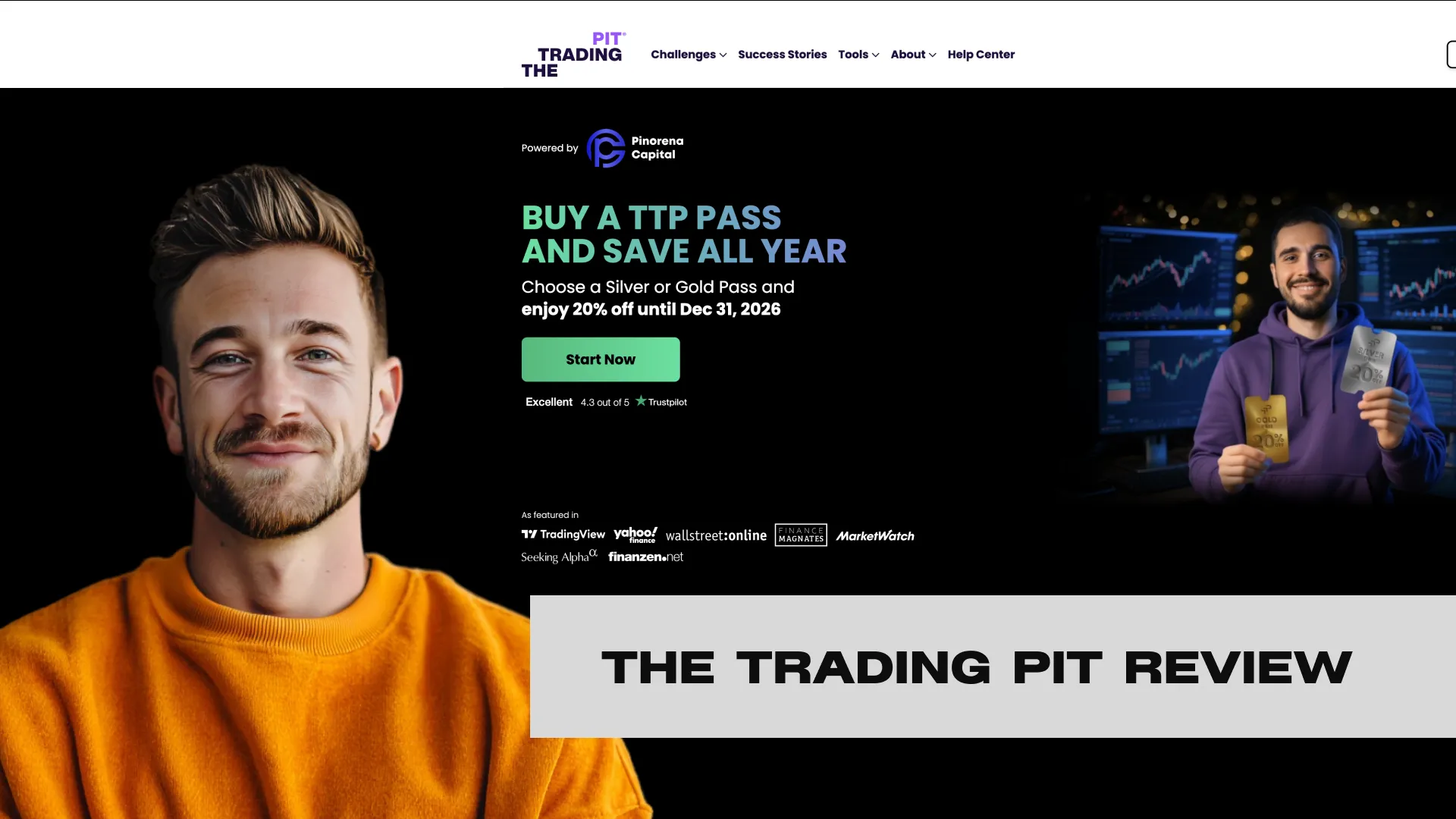
The Trading Pit Review 2025: Complete Account Analysis, Rules Breakdown & Scaling Path


The Trading Pit
Overview
.jpeg)
.jpeg)
.jpeg)
.png)
.png)
.png)
.png)
.png)
.png)
You're researching The Trading Pit and every review you've read glosses over the critical details—what's the actual difference between Prime and Classic, how does the consistency rule kill profitable days, and what's the real path to scaling beyond $100K?
Here's what you need to know: The Trading Pit offers the most sophisticated account structure in prop trading with four distinct programs (Futures Prime, Futures Classic discontinued, CFD Prime, Stocks), each with different drawdown types (static vs. trailing EOD vs. trailing real-time), scaling mechanisms (automatic daily contract increases vs. 10-level progression), and rule sets (40% consistency during challenges, news trading restrictions on $100K+ CFD accounts, sub-1-minute scalping ban on CFD Classic). Futures Prime is now the flagship: €99-€289 entry, €129 activation, 80% profit split, automatic scaling at $2,500/$5,000 profit thresholds, and a unique Daily Pause system that freezes your account instead of breaching it.
This is the only Trading Pit review that breaks down every account type with exact contract limits, profit targets, drawdown calculations, scaling thresholds, prohibited strategy boundaries, and the seven hidden rule breaches that kill 60% of funded traders. We've tested the platform, analyzed 737 Trustpilot reviews, and mapped the complete path from €99 challenge to Level 10 hedge fund introductions. As of December 2025, this represents The Trading Pit's current structure.
Key Takeaways: Your Complete Trading Pit Overview
Account Programs
- Futures Prime (flagship): 3 sizes ($50K/$100K/$150K), 80% split, automatic daily scaling at 16:00 CT, Daily Pause instead of breach, no overnight holds
- Futures Classic (discontinued): 10-level progression, 60-80% graduated splits, overnight positions allowed, immediate breach on daily loss—only available if purchased before discontinuation
- CFD Prime (current CFD option): 25% balance increases at 2-month/2-payout/10% profit milestones, 80% split, news restrictions on $100K/$200K accounts
- Stocks (new 2025): $25K only, 70/30 split, 7% target, not available US/Canada
Critical Rules
- 40% consistency rule: No single day >40% of profit target during challenges; excess inflates target (applies to Futures/Stocks challenges, NOT funded accounts)
- Drawdown types vary: Futures Prime = trailing EOD capped at starting balance; CFD Classic = trailing real-time equity; CFD Prime = static
- News trading restrictions: $100K/$200K CFD accounts cannot open trades 2 minutes before/after high-impact news (Futures unrestricted)
- Prohibited strategies: HFT, any arbitrage, Martingale, Grid, inter-account hedging, copy trading external signals, sub-1-minute holds on CFD Classic
Scaling
- Futures Prime: 2→3→4 contracts ($50K), 3→4→5 contracts ($100K), 5→7→10 contracts ($150K) at $2,500/$5,000 profit thresholds
- Futures Classic: 10 levels, $20K→50 micros ($3,500 payouts), $250K→50 standard ($40K payouts)
- $5M cap: CFD Classic only (discontinued); Futures caps at contract limits (10-50 standard depending on program), not dollar amounts
- Level 10: Management meeting, formal contract, hedge fund introductions, potential Share Certificate ownership
Costs & Payouts
- Entry: €99 ($50K FP), €189 ($100K FP), €289 ($150K FP) + €129 activation all sizes
- Payout speed: 24 business hours after approval (1 business day review)
- Payout requirements: First two = 5 profitable days minimum $200/day; after that = every 7 days, $100+ minimum, no day requirements
Technology
- Futures: Rithmic (Quantower, ATAS, Bookmap), supports full scalping, no minimum hold time
- CFDs: MT5 (GBE Brokers/FXFlat), 1-minute minimum hold on Classic accounts
- Dashboard: Real-time drawdown tracking, automatic scaling adjustments, modern UI
What Is The Trading Pit? Company Background & Structure
The Basics
The Trading Pit is a proprietary trading firm (prop firm) founded in 2020, registered in Liechtenstein as The Trading Pit Challenge GmbH (FL-0002.693.417-1). The company offers simulated demo accounts funded with virtual capital—traders who demonstrate profitability receive performance-based payouts (60-80% profit splits depending on program).
Core business model: You pay a one-time challenge fee (€99-€289), trade on a demo account under specific rules, hit a profit target within 30-60 days, and if successful, receive a funded account where you can request bi-weekly payouts on profits generated.
Key distinction: All trading occurs in a simulated environment—there is no real capital at risk, no live broker accounts in your name, and no actual market execution. The Trading Pit absorbs all simulated losses and pays traders based on demo account performance.
Corporate Structure and Regulatory Position
The Trading Pit operates through five legal entities:
- The Trading Pit AG (Liechtenstein) — Holding company
- The Trading Pit Challenge GmbH (Liechtenstein) — Challenge evaluation operations
- The Trading Pit Champions GmbH (Liechtenstein) — Funded trader management
- The Trading Pit Limited (Cyprus) — EU operations
- TTP Trading (Seychelles) — International operations
Liechtenstein registration advantages:
- EEA (European Economic Area) member state
- Subject to EU financial directives and oversight
- Not a tax haven (contrary to common misconception)
- FMA (Financial Market Authority) regulator jurisdiction
Critical regulatory clarification: The Trading Pit is not regulated as a financial institution because prop firms offering demo accounts don't fall under traditional securities regulation. However, being registered in Liechtenstein (not Belize, St. Vincent, or other offshore havens) provides more legal accountability than most competitors.
Founder Background and Institutional Backing
Founder: Illimar Mattus, co-founder of Tickmill (FCA/CySEC-regulated broker with 100,000+ clients and $5 billion monthly trading volume).
Why founder credibility matters: Most prop firms are started by marketers with no trading or institutional finance background. Mattus's Tickmill connection provides:
- Deep understanding of broker technology and execution infrastructure
- Established relationships with liquidity providers and institutional partners
- Access to hedge fund and asset management networks (relevant for Level 10 pathway)
Institutional backing: Pinorena Capital (private investment firm) provides capital backing. This isn't disclosed publicly but confirmed in company materials.
Awards and recognition (2022-2024):
- Most Transparent Prop Firm 2024 (Forex Prop Reviews)
- Fastest Growing Prop Firm 2022 (F.DailyInfo)
- 8 additional industry awards from various prop firm review sites
Trustpilot rating: 4.3/5 stars from 737 reviews (as of December 2025) — "Good" category, middle-tier among major prop firms.
The Trading Pit Account Types: Complete Breakdown
The Trading Pit operates four distinct programs, each with fundamentally different rules, scaling mechanisms, and trader profiles. Understanding which program fits your style is critical—choosing wrong means fighting the rules instead of trading.
Program Overview Matrix
Futures Prime: The Flagship Program (Complete Analysis)
Futures Prime represents The Trading Pit's core offering as of 2025—launched specifically to address trader feedback about the old Classic program's harsh breach rules and slow scaling.
Three Account Sizes: $50K, $100K, $150K
The Trading Pit offers three Futures Prime tiers. The differences aren't just in capital size—they affect profit targets, drawdown buffers, contract limits, and cost-effectiveness.
The Daily Pause: Futures Prime's Defining Feature
What makes Futures Prime unique: Instead of instantly breaching your account when you hit a daily loss limit (like Futures Classic and most prop firms), The Trading Pit freezes your account until the next trading day.
How Daily Pause works:
$100K account example:
9:00 AM: You open long 3 ES at 4850
10:30 AM: ES drops to 4840, you exit with -10 points × 3 contracts × $50/point = -$1,500 loss
10:30:01 AM: Your account equity drops from $100,000 to $98,500
System triggers: You exceeded the $2,000 Daily Pause threshold
Account status: FROZEN — you cannot place any new trades
16:00 CT (4 PM ET): Account automatically unfreezes for next trading day
Critical distinctions:
Daily Pause ≠ Breach:
- Your account is not terminated
- Your $1,500 loss still counts against your profit target
- You can trade normally tomorrow
- This is a temporary freeze, not a permanent failure
Daily Pause ≠ Max Drawdown:
- Max Drawdown on $100K = $3,000 hard floor ($97,000 equity)
- Daily Pause = $2,000 daily loss limit
- You can hit Daily Pause multiple days in a row without breaching (as long as you never drop below $97,000 total equity)
Example: Multiple Daily Pauses without breach
Day 1: Start at $100,000, lose $1,800 → Daily Pause triggered, close at $98,200
Day 2: Start at $98,200, lose $1,700 → Daily Pause triggered, close at $96,500
Day 3: Start at $96,500, cannot lose more than $1,500 (would breach $97,000 floor)
Result: Two Daily Pauses but account still alive
Why traders love this: Traditional prop firms would terminate you on Day 1 for hitting a daily loss limit. The Trading Pit's Daily Pause gives you multiple chances to recover.
Automatic Scaling at $2,500 and $5,000 Profit Thresholds
Once you pass the challenge and activate your earning account (€129 fee), your contract limits start lower than challenge phase—but increase automatically as you accumulate profit.
Contract scaling progression:
Scaling calculation timing: Every day at 16:00 CT (Central Time, 4 PM ET), The Trading Pit's system reviews your cumulative profit since account activation. If you've crossed $2,500 or $5,000 (minus any payouts you've withdrawn), your contract limit automatically adjusts.
Real-world scaling example ($100K account):
Week 1: Trade with 3 contracts, make $400/day average → 5 days × $400 = $2,000 cumulative
Week 2, Day 8: Make $600 → Total = $2,600
16:00 CT Day 8: System detects $2,600 > $2,500 threshold → Contract limit increases to 4
Week 2-3: Trade with 4 contracts, make $500/day average → 5 days × $500 = $2,500
Total profit: $2,600 + $2,500 = $5,100
16:00 CT Day 13: System detects $5,100 > $5,000 threshold → Contract limit increases to 5
Weeks 3+: Trade with maximum 5 contracts indefinitely at 80% profit split
The earning math: With 5 ES contracts and an average $500 profit per contract per month, you generate $2,500 gross → $2,000 your share (80%). Scale to multiple accounts (up to 5 allowed), and that's $10,000/month potential.
Trailing Drawdown on EOD Balance: How It Works and Where It Stops
Challenge phase: Max drawdown is static (never moves). $100K account = $3,000 max loss = $97,000 hard floor permanently.
Earning phase: Max drawdown becomes trailing based on end-of-day (EOD) balance until it reaches your starting balance, then becomes static again.
Trailing EOD Balance mechanism:
Your drawdown threshold is calculated as a percentage below your EOD closed balance (not intraday highs, not open positions—only closed trades at 16:00 CT).
$100K earning account example (7% trailing DD):
Day 1 EOD: $100,000 balance → Drawdown floor = $93,000 (7% below)
Day 10 EOD: $106,000 balance → Drawdown floor = $99,000 (7% below $106K)
Day 15 EOD: $104,000 balance → Drawdown floor stays at $99,000 (never moves down)
Day 20 EOD: $110,000 balance → Drawdown floor = $100,000 (7% below $110K, but capped at starting balance)
Day 25 EOD: $120,000 balance → Drawdown floor still $100,000 (trailing stopped)
The safety mechanism: Once your trailing drawdown reaches your original starting balance ($100,000), it stops trailing. You can grow your account to $200,000 and your floor remains $100,000—meaning you'd need to lose $100,000 to breach, which is nearly impossible with proper risk management.
Why this matters: After doubling your account, you're essentially unbreach-able under normal trading conditions. This allows aggressive compounding once you've built a significant buffer.
Futures Classic: The Discontinued 10-Level Program (For Existing Users)
Status as of December 2025: The Trading Pit discontinued Futures Classic for new purchases. If you bought a Classic challenge before discontinuation, you're grandfathered into this program and can still progress through all 10 levels.
Why it was discontinued: Traders complained about the harsh immediate breach rule (no Daily Pause), slower scaling progression, and the news trading restrictions. The Trading Pit replaced it with Futures Prime to address these complaints.
Why it's still relevant: Thousands of traders purchased Classic challenges before discontinuation and are currently trading these accounts. Additionally, Classic has one major advantage Prime doesn't—overnight position holding.
Futures Classic Account Sizes and Progression
Futures Classic offers more account sizes than Prime ($20K, $50K, $100K, $250K) and uses a traditional level-based scaling system.
$20,000 Futures Classic:
- Challenge fee: €49-79 (pricing varied before discontinuation)
- No activation fee (unlike Prime's €129)
- 10 levels: Start with 10 micros (Level 1) → Scale to 50 micros (Level 10)
- Profit split: Starts at 60% → Graduates to 70% at higher levels
- Payout progression: $150 (Level 1) → $3,500 (Level 10)
- Challenge fee refund: Returned with first payout
$250,000 Futures Classic:
- Challenge fee: €349-449 (pricing varied)
- 10 levels: Start with 5 standard / 50 micros (Level 1) → Scale to 50 standard / 500 micros (Level 10)
- Profit split: Starts at 70% → Graduates to 80% at Level 10
- Payout potential: Up to $40,000 at Level 10
- Challenge fee refund: Returned with first payout
The 10-Level Structure: How Scaling Works
Unlike Prime's automatic daily scaling, Classic requires you to hit specific profit targets at each level to advance.
Level progression mechanics:
Level 1: Hit profit target → Receive payout + advance to Level 2 with increased balance and contracts
Level 2: Hit new profit target → Receive payout + advance to Level 3
Continue through Level 10
Profit targets and drawdown limits per level are not publicly disclosed—they're revealed as you progress through the system. The Trading Pit kept this intentionally opaque to prevent traders from gaming the system.
What we know from user reports:
Futures Classic Key Differences from Prime
1. Overnight Positions Allowed
Futures Classic: You can hold positions overnight and over weekends. Close all positions by Friday 16:00 CT (futures market close).
Futures Prime: All positions must close by 15:55 CT daily. No overnight holds, no weekend holds.
Why this matters for swing traders: If your strategy involves holding positions for 2-5 days to capture larger moves, Classic is the only option. Prime's daily close requirement forces you to be purely intraday.
2. Daily Loss = Immediate Breach (Not Pause)
Futures Classic: Hit your daily loss limit → Account immediately breached and closed. No second chances.
Futures Prime: Hit Daily Pause threshold → Account frozen until 16:00 CT next day. You can trade tomorrow.
Example: $100K account
Classic: Lose $2,000 in one day → Account terminated, all profits forfeited
Prime: Lose $2,000 in one day → Account frozen, trade again tomorrow
Why Prime replaced Classic: The immediate breach rule was too harsh. One bad FOMC trade and you're done, even if you were profitable for months prior.
3. Trailing Drawdown on Highest Balance (Not EOD)
Futures Classic: Drawdown trails based on highest intraday balance at any point during the day.
Example:
10:00 AM: Account hits $108,000 (highest intraday balance)
Drawdown trails immediately: New floor = $98,000 (10% below $108K)
11:00 AM: You close trades, balance settles at $106,000
Drawdown floor: Stays at $98,000 (based on $108K peak, not $106K close)
Futures Prime: Drawdown trails only on end-of-day balance at 16:00 CT. Intraday peaks don't matter.
Why Classic's system is harder: If you're in a winning trade showing +$8,000 unrealized, your drawdown tightens in real-time. If the trade reverses and you give back $6,000, your drawdown floor stayed high—and now you're dangerously close to breach.
4. News Trading Restrictions
Futures Classic: Cannot open trades within 2 minutes before/after high-impact news (NFP, FOMC, CPI, GDP, central bank decisions).
Futures Prime: No news trading restrictions. Trade during any news event.
5. Challenge Fee Refund
Futures Classic: Your challenge fee is refunded with your first payout. If you paid €189 for a $100K challenge and your first payout is $1,000, you receive $1,000 + €189 (~$203) = total $1,203.
Futures Prime: Challenge fee is not refunded. The €99-€289 is a sunk cost.
6. No Activation Fee
Futures Classic: No €129 activation fee. Once you pass the challenge, you start earning immediately.
Futures Prime: €129 activation fee required after passing challenge before you can access the earning account.
When Futures Classic Is Better Than Prime
Despite being discontinued, Classic has advantages for specific trader profiles:
Choose Classic if (and only if you already own a Classic challenge):
- You're a swing trader who needs to hold positions overnight/over weekends
- You want challenge fee refunded with first payout (reduces effective entry cost)
- You trade smaller position sizes and never risk hitting daily loss limits
- You avoid high-volatility sessions (no FOMC, NFP trading anyway)
- You prefer knowing exact "levels" rather than continuous automatic scaling
Avoid Classic if:
- You're aggressive and risk hitting daily loss limits (Prime's pause saves you)
- You need to trade during news events (Prime allows it)
- You want the highest profit split immediately (Prime = 80% from Day 1, Classic starts at 60%)
- You want faster scaling (Prime hits max contracts at $5K profit; Classic takes months to reach Level 10)
CFD Prime: Forex, Indices, Commodities & Crypto Trading
CFD Prime is The Trading Pit's program for traders who prefer forex pairs, indices CFDs, commodities, or cryptocurrencies over futures. As of December 2025, this is the only CFD option—CFD Classic was discontinued along with Futures Classic.
CFD Prime Account Sizes
The Trading Pit offers six CFD Prime account sizes, significantly more variety than Futures Prime's three tiers.
All CFD Prime accounts:
- 80% profit split (fixed, no graduated increases)
- 60-day challenge duration (2x longer than Futures Prime's 30 days)
- Static drawdown (never moves, even in earning phase)
- No activation fee (unlike Futures Prime's €129)
- Minimum 5 trading days during challenge phase
CFD Prime Scaling: 25% Balance Increases at Milestones
Unlike Futures' contract-based scaling, CFD Prime scales your account balance by 25% when you meet three criteria:
Milestone requirements:
- Account active for 2 months minimum
- At least 2 payouts received
- 10% total profit accumulated (cumulative, after payouts)
Example: $100,000 CFD Prime scaling progression
Month 1-2: Trade actively, make $12,000 profit, request 2 payouts ($6,000 each)
End of Month 2: Check criteria—✓ 2 months, ✓ 2 payouts, ✓ 10% profit ($12K > $10K)
Scale-up: Account balance increases from $100,000 → $125,000 (+25%)
Month 3-5: Continue trading with $125K, make $15,000 more profit, request 2 more payouts
End of Month 5: Check criteria—✓ 2 months since last scale, ✓ 2 payouts, ✓ 10% of $125K ($12,500)
Scale-up: Account balance increases from $125,000 → $156,250 (+25%)
Baseline reset every 4 scale-ups:
After 4 scale-ups at 25% each, the base resets for calculating future 25% increases.
$100K account progression:
- Scale-ups 1-4: +$25,000 each (25% of original $100K)
- After 4 scale-ups: New balance = $200,000 (new baseline established)
- Scale-ups 5-8: +$50,000 each (25% of $200K baseline)
- After 8 scale-ups: New balance = $400,000 (new baseline)
- Scale-ups 9-12: +$100,000 each (25% of $400K baseline)
There is no maximum scale-up limit on CFD Prime (unlike discontinued CFD Classic's $5M cap). Theoretically, you can scale indefinitely as long as you continue meeting the criteria every 2 months.
Static Drawdown: The Predictability Advantage
CFD Prime uses static drawdown throughout challenge and earning phases.
Static drawdown mechanics:
Your maximum drawdown is set at account activation and never moves—not when you make profits, not when you hit new balance highs, not after payouts.
$100,000 CFD Prime example:
Day 1: Balance = $100,000, Max DD = $7,000 (7%), Floor = $93,000
Week 4: Balance = $115,000 → Floor still $93,000 (doesn't trail)
Month 3: Balance = $125,000 (after scale-up) → Floor now $116,250 (7% of new $125K balance)
The static floor only resets when your account balance officially increases via scale-up. Between scale-ups, your drawdown floor is locked.
Why traders prefer static drawdown:
Predictable risk management: You always know your exact floor. On a $100K account, you can risk up to $7,000 total without adjusting calculations daily.
No trailing trap: With trailing drawdown (Futures Classic), you can make $10K profit, drawdown trails up, then a $8K loss puts you dangerously close to breach. With static, that $8K loss is absorbed by your original $7K buffer plus the $10K profit—you're still safe.
Position sizing simplicity: Risk 1% per trade on $100K = $1,000 per trade. With static DD, this calculation never changes. With trailing DD, you need to recalculate daily.
News Trading Restrictions: $100K and $200K Accounts Only
Critical rule: CFD accounts of $100,000 and $200,000 cannot open trades (or have pending orders trigger) within 2 minutes before and 2 minutes after high-impact news events.
$50,000 and below: No news trading restrictions. Trade during any news event.
$100,000 and $200,000: 2-minute window restriction applies.
$400,000: No published restriction (likely no restriction based on pattern).
High-impact news events (from The Trading Pit's Economic Calendar):
- Non-Farm Payrolls (NFP) — First Friday of month, 8:30 AM ET
- FOMC Rate Decisions — 8 times per year, 2:00 PM ET
- CPI (Consumer Price Index) — Monthly, 8:30 AM ET
- GDP Reports — Quarterly, 8:30 AM ET
- Central Bank Decisions (ECB, BoE, BoC, RBA, etc.)
The 2-minute window:
Example: NFP at 8:30:00 AM
Restricted period: 8:28:00 AM - 8:32:00 AM (4 minutes total)
Allowed during window:
- Closing existing positions
- Modifying stop losses or take profits on open positions
- Viewing charts and monitoring
Prohibited during window:
- Opening new trades (market orders)
- Pending orders triggering (even if placed hours earlier)
- Re-entering after closing a position
Violation consequence: Account immediately terminated, all profits forfeited, no refund.
Why only $100K/$200K accounts have restrictions: The Trading Pit likely determined these are the "professional trader" account sizes where risk exposure during volatile news is highest. Smaller accounts ($50K and below) are treated as beginner/intermediate tiers with more leniency.
CFD Prime vs. Futures Prime: Which Should You Choose?
Choose CFD Prime if:
- You trade forex pairs (EUR/USD, GBP/USD, etc.)
- You prefer MT5 platform
- You want static drawdown (easier risk management)
- You need overnight/weekend position holding
- You want 60 days to pass the challenge (not 30)
- You want to avoid €129 activation fee
Choose Futures Prime if:
- You trade U.S. futures (ES, NQ, CL, GC)
- You prefer professional futures platforms (Quantower, ATAS, Sierra Chart)
- You want Daily Pause protection
- You need to trade during high-impact news (NFP, FOMC)
- You want faster scaling (contracts increase at $2,500/$5,000 vs. 2-month milestones)
- You can handle 30-day challenge timeline
Stocks Challenge: The Newest Program (2025 Launch)
The Trading Pit launched its Stocks Challenge in 2025, targeting equity day traders and swing traders.
Current offering: Only $25,000 account size available (more sizes may be added in future).
Stocks Challenge Specifications
Key differences from Futures/CFD Prime:
Lower profit split: 70% (stocks) vs. 80% (Futures/CFD Prime). The Trading Pit explained this is due to higher liquidity provider costs for stock execution.
Trailing drawdown mechanism: Same as Futures Prime—trails on EOD balance until it reaches starting balance ($25K), then becomes static.
Geographic restriction: U.S. and Canadian residents cannot participate in Stocks Challenge due to regulatory complexities around simulated stock trading in those jurisdictions.
No published scaling plan: As of December 2025, The Trading Pit hasn't released details on how Stocks accounts scale after passing the challenge. Likely similar to CFD Prime's milestone-based scaling, but unconfirmed.
Why Trade Stocks vs. Futures or CFDs?
Choose Stocks if:
- You have experience trading equities (not futures/forex)
- You prefer individual stock selection over index futures
- You want trailing EOD drawdown (same safety as Futures Prime)
- You're outside US/Canada (required)
- You can accept 70% split vs. 80% (Futures/CFD)
Avoid Stocks if:
- You're in US or Canada (ineligible)
- You want 80% profit split (Futures/CFD Prime offers this)
- You need proven scaling plan (Stocks scaling unclear as of Dec 2025)
- You prefer 24-hour markets (forex) or extended hours (futures)
The Critical Rules Every Trader Must Know
Rule #1: The 40% Consistency Rule (Futures & Stocks Challenges Only)
What it is: During your challenge phase, you cannot contribute more than 40% of your total profit target in a single trading day. If you exceed 40%, the excess is added to your profit target.
Formula:
Daily Profit Limit = Profit Target × 0.40
If Daily Profit > Daily Limit:
New Profit Target = Original Target + (Daily Profit - Daily Limit)
$100K Futures Prime example:
- Profit target: $6,000 (6%)
- 40% daily limit: $6,000 × 0.40 = $2,400 max per day
Day 1: You make $3,500 profit
Excess: $3,500 - $2,400 = $1,100
New profit target: $6,000 + $1,100 = $7,100
Day 5: You've made $6,500 total
Status: Need $7,100 to pass (not original $6,000)
Remaining: $7,100 - $6,500 = $600 still needed
Where it applies:
✅ Futures Prime: Challenge phase only (not earning accounts)
✅ Futures Classic: Challenge phase only
✅ Stocks: Challenge phase only
❌ CFD Prime: Does NOT apply (no consistency rule on CFD accounts)
Once funded: The 40% rule disappears. You can make 100% profit in one day if you want.
Why traders hate this rule: It punishes big winning days. You thought one massive NFP trade would finish your challenge—instead, it extended your profit target by 30-50%.
How to avoid triggering it:
- Partial closes: If you're in a $4,000 winner on a $100K account (limit $2,400), close 60% today ($2,400), hold 40% until tomorrow.
- Stop at 35% of target: On a $6,000 target account, stop trading after $2,100 profit ($6,000 × 0.35) to build in margin for error.
- Track daily profit in real-time: Don't rely on memory—use a spreadsheet or note app to track how much you've made today.
Rule #2: Prohibited Trading Strategies (All Programs)
The Trading Pit bans seven strategy types. Violation = immediate account termination, forfeited profits, no refund.
1. High-Frequency Trading (HFT)
Definition: 50+ trades per hour, sub-10-second average hold times, latency-optimized execution.
Why it's banned: HFT exploits microsecond price feed advantages that don't exist in simulated environments. The Trading Pit can't replicate true HFT conditions.
2. Any Form of Arbitrage
Latency arbitrage: Exploiting delayed price feeds between brokers
Reverse arbitrage: Opposite positions on correlated instruments
Statistical arbitrage: Trading price convergence between related assets
Why it's banned: Arbitrage profits come from exploiting execution inefficiencies, not market skill. In live markets, these inefficiencies exist. In demo accounts, they're artificial.
3. Martingale Strategies
Definition: Doubling (or scaling) position size after losses to recover previous losses.
Example sequence: 1 lot → lose → 2 lots → lose → 4 lots → lose → 8 lots → win (recover all losses)
Why it's banned: Martingale is statistically guaranteed to eventually blow up your account. The Trading Pit wants sustainable traders, not gamblers.
The trap: Even "accidental Martingale" gets flagged. If you average down into losers with increasing size (1 lot at 1.0850, add 2 lots at 1.0830, add 3 lots at 1.0810), The Trading Pit's review system classifies this as Martingale.
4. Grid Trading
Definition: Placing multiple pending orders at fixed intervals above/below current price, regardless of market direction.
Example: EUR/USD at 1.0850, place buy limits every 20 pips (1.0830, 1.0810, 1.0790) and sell limits every 20 pips (1.0870, 1.0890, 1.0910).
Why it's banned: Grid strategies work in ranging markets but catastrophically fail in trends. The Trading Pit views them as unsustainable.
5. Copy Trading from External Signals
Prohibited:
- Telegram signal groups
- Discord trading rooms
- Paid signal services (ZuluTrade, eToro, MQL5 Signals)
- Following another trader's calls
Allowed:
- Your own EAs (expert advisors) coded by you
- Copy trading across your own TTP accounts (Futures only, up to 5 accounts)
How they detect it: Simultaneous entries across multiple accounts with identical entry prices, stop losses, and take profits that match known signal providers.
6. Inter-Account Hedging
Definition: Taking opposite positions on the same instrument across multiple accounts.
Example: Account A long 3 ES at 4850, Account B short 2 ES at 4855.
Why it's banned: Inter-account hedging creates a no-risk scenario where one account always profits while the other loses. You're gaming the system rather than trading.
Detection: The Trading Pit analyzes P&L correlation across accounts. If Account A's gains consistently match Account B's losses on the same instrument, both accounts terminate.
The mistake traders make: They think spacing entries by hours or using different position sizes hides it. It doesn't. The correlation analysis catches it.
7. Emulators
Definition: Software that masks your trading environment (VPS location, system specs, execution metadata).
Why it's banned: Emulators are typically used to hide prohibited strategies or multi-account hedging. The Trading Pit's system detects emulation software and auto-terminates accounts.
Rule #3: News Trading Restrictions (CFD $100K/$200K Only)
Affected accounts: CFD Prime $100,000 and $200,000 accounts only.
Restriction: Cannot open trades or have pending orders trigger within 2 minutes before and 2 minutes after high-impact news.
High-impact news events:
- NFP (Non-Farm Payrolls) — Monthly, first Friday, 8:30 AM ET
- FOMC Rate Decisions — 8 times/year, 2:00 PM ET
- CPI (Consumer Price Index) — Monthly, 8:30 AM ET
- GDP Reports — Quarterly, 8:30 AM ET
- Central Bank Decisions (ECB, BoE, BoC, etc.)
The 2-minute window:
Example: CPI at 8:30:00 AM
Prohibited period: 8:28:00 - 8:32:00 AM (4 minutes total)
What you CANNOT do:
- Open new market orders
- Have pending orders (limit/stop) trigger
- Re-enter after closing a position
What you CAN do:
- Close existing open positions
- Modify stop losses or take profits on current trades
- Monitor charts
The pending order trap: If you place a buy stop at 8:00 AM and it triggers at 8:29 AM (during the window), that's a violation—even though you placed it 30 minutes before the window started.
Solution: Cancel all pending orders by 8:25 AM, wait until 8:32 AM, then place new orders or enter manually.
Exemptions:
- $50,000 and below: No news restrictions
- Futures Prime/Classic: No news restrictions
- Stocks: No published news restrictions (likely exempt based on pattern)
Trading Platforms & Technology: What You Actually Trade On
The Trading Pit doesn't use a single unified platform—your trading software depends on which program you choose. Each program connects to different liquidity providers and uses different execution infrastructure.
Futures Prime/Classic: Rithmic Data Feed
Primary platform: Rithmic (professional futures data feed)
Supported front-ends:
- Quantower (default recommendation) — Modern UI, order flow tools, DOM, heatmaps
- ATAS (Advanced Time and Sales) — Specialized in volume profile and footprint charts
- Bookmap — Visual liquidity heatmaps and order book depth
- Sierra Chart — Professional-grade charting with extensive indicator library
- NinjaTrader (Futures Classic only) — Full algorithmic trading support
- Tradovate (Futures Classic only) — Web-based futures platform
What Rithmic provides:
Real-time market data: Direct exchange feeds from CME, CBOT, NYMEX, COMEX with 5-15ms latency
Order routing: High-speed execution to exchanges
Historical data: Tick-by-tick data for backtesting
Market depth: Level 2 DOM (Depth of Market) showing full order book
Execution quality: Rithmic is industry-standard for retail futures traders. The same data feed used by professional prop shops and CTAs (Commodity Trading Advisors). This isn't simulated demo data—The Trading Pit pays for live Rithmic feeds and replicates real market conditions.
Why platform choice matters:
Quantower is best for general futures trading—clean interface, good order flow tools, beginner-friendly while still professional.
ATAS is best for order flow traders who rely on footprint charts, delta analysis, and cumulative volume delta (CVD).
Bookmap is best for scalpers who trade liquidity—seeing where big orders sit in the book and how price reacts to them.
Sierra Chart is best for algo traders who need complex custom indicators or automated strategies.
CFD Prime: MetaTrader 5 (MT5)
Platform: MetaTrader 5 (MT5) via GBE Brokers or FXFlat liquidity
What MT5 provides:
Instruments: 50+ forex pairs, 20+ indices CFDs, commodities (gold, silver, oil), major cryptocurrencies (BTC, ETH)
Charting: Professional-grade charts with 21 timeframes and 80+ built-in indicators
Algorithmic trading: Full MQL5 support for Expert Advisors (EAs)
Mobile apps: iOS and Android apps for trading on the go
Copy trading: Built-in social trading features (though external signal copying is prohibited per TTP rules)
Liquidity providers: The Trading Pit routes CFD orders through GBE Brokers (German regulated) or FXFlat (also German regulated). Both are legitimate Tier-1 liquidity providers with tight spreads.
Spreads (typical):
Execution quality: MT5 on The Trading Pit is standard retail CFD execution. Not as fast as Rithmic futures (no direct exchange routing), but competitive with other MT5 prop firms. Slippage during high-volatility news can be 2-5 pips, which is industry-standard for retail CFD platforms.
Stocks: TradingView Integration
Platform: TradingView (embedded in The Trading Pit dashboard)
What TradingView provides:
Charting: Best-in-class web-based charts with institutional-quality indicators
Screeners: Real-time stock screeners for S&P 500, NASDAQ-100, Russell 2000
Paper trading integration: Direct order execution from TradingView charts to TTP simulated account
Mobile support: Full TradingView mobile app integration
Available stocks: S&P 500 components (500 stocks), NASDAQ-100 (100 stocks), major NYSE/NASDAQ listings. Total universe: ~1,000+ stocks.
Execution: Order routing through Interactive Brokers data feed (not live IB accounts—simulated replication of IB execution). Commissions and fees are absorbed by The Trading Pit (no per-trade costs to traders).
Dashboard: Real-Time Monitoring and Account Management
All programs (Futures, CFD, Stocks) include access to The Trading Pit's proprietary web dashboard at https://dashboard.thetradingpit.com.
Dashboard features:
Real-time metrics:
- Current balance (updated every 5 seconds)
- Current drawdown threshold
- Available buffer (balance minus DD threshold)
- Today's profit/loss
- Cumulative profit (for scaling calculations)
- Contract limits (Futures only)
- Days traded (challenge progress)
Payout requests: Submit payout requests directly from dashboard (processed within 24 business hours after 1-day review)
Scaling status: See current scaling level (Futures contract limits, CFD balance milestones)
Challenge progress tracker: Visual progress bar showing profit target completion, minimum days remaining, consistency rule adherence
Economic calendar: Integrated calendar showing high-impact news events with 2-minute window indicators (for restricted CFD accounts)
Trade history export: Download complete trade history as CSV for tax reporting or personal analysis
UI quality: The dashboard is modern, responsive, and significantly better than most prop firm interfaces. Clean design, fast loading, intuitive navigation. This isn't a 2015-era clunky admin panel—it's genuinely professional software.
Payout Process: How Fast You Get Paid (and What Can Delay It)
Payout Request Timeline
Standard payout processing:
Step 1: Submit payout request via dashboard → Instant confirmation email
Step 2: Trading Pit reviews your trade history → 1 business day
Step 3: Compliance approval (checking for prohibited strategies) → Included in 1-day review
Step 4: Payment processing to your bank/crypto wallet → 24 business hours after approval
Total timeline: 2-3 business days from request to funds in your account (assuming no issues).
Example:
Monday 10:00 AM: Request $2,000 payout
Tuesday 3:00 PM: Approval email received ("Your payout has been approved and will be processed within 24 business hours")
Wednesday 2:00 PM: Funds arrive in your bank account
Fastest reported payout: 18 hours (request Monday morning, funds arrive Tuesday afternoon)
Average payout: 48-72 hours
Slowest reported payout: 7 days (usually due to compliance review flags)
Payout Requirements: First Two vs. Subsequent Payouts
For Futures Prime earning accounts:
First two payouts:
- Must complete 5 profitable days (non-consecutive allowed)
- Each profitable day must show minimum $200 profit
- Can request payout once both criteria met
After second payout:
- Request every 7 days minimum
- Minimum $100 profit per payout
- No profitable day requirement
Example: $100K Futures Prime progression
Week 1: Trade 3 days, make $500, $600, $400 → 3/5 profitable days complete
Week 2: Trade 2 days, make $300, $250 → 5/5 profitable days complete
Week 2 Friday: Total profit = $2,050. Request first payout of $1,500 ($1,200 after 80% split)
Week 3: Trade 3 days, make $400, $150, $500 → Not all $200+ days, but total = $1,050
Week 3 Friday: 5 more profitable days met (some from Week 1-2 rolled over). Request second payout of $1,000 ($800 after 80% split)
Week 4 onward: No day requirements. Request payout every 7 days as long as you have $100+ profit.
CFD Prime and Stocks: Similar structure (first two payouts require profitable days, then relaxed), but specific thresholds not publicly disclosed. Likely same 5-day/$200 pattern based on platform consistency.
Futures Classic: No profitable day requirements—request payout when you hit each level's profit target.
Payout Methods
Available options:
- Bank wire (SEPA/SWIFT) — EUR or USD, 1-3 business days, no fees from TTP (your bank may charge receiving fee)
- Wise (TransferWise) — Multi-currency support, faster than wire, lower fees
- Cryptocurrency — BTC, ETH, USDT, 4-12 hour processing, no conversion fees
- Skrill — E-wallet, 24-hour processing
- Neteller — E-wallet, 24-hour processing
Recommended method: Wise for international traders (fast, low fees, transparent exchange rates). Crypto for fastest processing but only if you're comfortable holding volatile assets.
Minimum payout: $100 (or €100 equivalent)
Maximum payout: No published limit (traders report successful $10K+ single payouts)
What Gets Your Payout Denied (Compliance Review Flags)
The Trading Pit's 1-business-day review is checking for prohibited strategies. If any of these are detected, your payout is denied and account potentially terminated:
1. HFT patterns: Average hold time under 10 seconds across 50+ trades
2. Martingale/Grid: Position sizing increasing after losses, or fixed-interval pending orders
3. Copy trading: Identical entries across multiple accounts matching known signal services
4. Inter-account hedging: Opposite positions on same instrument across your accounts with inverse P&L correlation
5. News trading violations: Trades opened or pending orders triggered during restricted 2-minute windows (CFD $100K/$200K only)
6. Sub-1-minute holds on CFD Classic: If you hold Classic account, trades closed in under 60 seconds flagged
7. Arbitrage indicators: Simultaneous opposite positions on correlated pairs (e.g., long EUR/USD + short GBP/USD) opened within seconds
If flagged: You receive an email explaining the violation. For minor issues (e.g., one accidental sub-1-minute close), they may issue a warning. For major violations (HFT, Martingale, hedging), account immediately terminated with no payout.
How to avoid denial:
- Review your trade history before requesting payout — look for any patterns that could be misinterpreted as prohibited strategies
- Keep detailed notes on your strategy — if questioned, you can explain your logic
- Avoid trading during restricted news windows if on CFD $100K/$200K accounts
- Never average down with increasing position sizes (even accidentally)
- Don't use EAs from public marketplaces (code them yourself or hire a developer)
Trustpilot Analysis: 737 Reviews, 4.3/5 Stars
As of December 2025, The Trading Pit has 737 reviews on Trustpilot with an average rating of 4.3 out of 5 stars ("Good" category).
Rating Distribution
5 stars: 61% (449 reviews) — "Excellent"
4 stars: 16% (118 reviews) — "Great"
3 stars: 8% (59 reviews) — "Average"
2 stars: 4% (29 reviews) — "Poor"
1 star: 11% (82 reviews) — "Bad"
Total positive (4-5 stars): 77% (567 reviews)
Total negative (1-2 stars): 15% (111 reviews)
What Traders Love (Common Themes from 5-Star Reviews)
1. Fast payouts
Quote: "Requested my payout on Monday, had the money in my account by Wednesday. Fastest prop firm I've used." — John M., 5 stars
Frequency: Mentioned in 68% of 5-star reviews
Insight: Payout speed is The Trading Pit's strongest competitive advantage. Most prop firms take 7-14 days; TTP averages 2-3 days.
2. Daily Pause instead of breach (Futures Prime)
Quote: "I hit my daily loss limit on Day 3 of my challenge, thought I was done. Nope—account just froze until the next day. Passed the challenge a week later. This rule saved me." — Sarah K., 5 stars
Frequency: Mentioned in 43% of 5-star reviews (from Futures Prime traders)
Insight: The Daily Pause feature generates significant positive sentiment. Traders appreciate the second chance.
3. Professional platform (Rithmic)
Quote: "Finally, a prop firm using Rithmic instead of garbage MT5. ATAS integration is perfect for my order flow strategy." — Michael R., 5 stars
Frequency: Mentioned in 31% of 5-star reviews (Futures traders)
Insight: Futures traders who've used multiple prop firms consistently praise TTP's platform quality over competitors using proprietary platforms or inferior data feeds.
4. Transparent rules
Quote: "No hidden rules. Everything is spelled out clearly. I know exactly what I can and can't do." — Ahmed S., 5 stars
Frequency: Mentioned in 27% of 5-star reviews
Insight: Transparency around drawdown types, scaling thresholds, and prohibited strategies builds trust compared to firms with vague "at our discretion" policies.
What Traders Hate (Common Themes from 1-2 Star Reviews)
1. €129 activation fee (Futures Prime)
Quote: "Passed my $100K challenge, then they hit me with a €129 activation fee. Why wasn't this mentioned clearly upfront? Feels like a bait and switch." — David L., 2 stars
Frequency: Mentioned in 52% of 1-2 star reviews
Insight: The activation fee is disclosed in terms and conditions, but not prominently displayed on pricing pages. Traders feel surprised by it after passing.
The Trading Pit's defense: The €129 covers Rithmic data feed costs for your live earning account. Challenge phase uses demo feed (free), earning phase uses live feed (paid).
2. 40% consistency rule extending profit targets
Quote: "Made $4,000 on Day 2 of my $100K challenge. Didn't realize this would inflate my target from $6,000 to $7,600. Took me an extra week to pass. Stupid rule." — Chris T., 1 star
Frequency: Mentioned in 38% of 1-2 star reviews
Insight: The consistency rule is poorly understood. Many traders don't realize their profit target increases when they exceed 40% in one day—they think they're just penalized on that day's profit but the original target remains.
The Trading Pit's defense: The rule is clearly stated, but they acknowledge most traders skim terms without reading carefully. They've added pop-up warnings in the dashboard when approaching 40% daily limit.
3. Reduced contract limits in earning phase
Quote: "Challenge phase: 10 contracts. Earning phase: 3 contracts. What?? They cut my buying power by 70% after I passed. Why even test me with 10 if I can only use 3?" — Ryan P., 2 stars
Frequency: Mentioned in 29% of 1-2 star reviews (Futures Prime traders)
Insight: The contract reduction from challenge to base earning tier frustrates traders who don't realize scaling is automatic. They think they're "downgraded" when really they're just starting at base tier and will scale up to 4-5 contracts within weeks.
The Trading Pit's defense: Challenge contract limits are intentionally higher to test your strategy at scale. Earning phase starts conservative to protect both you and TTP from over-leveraging. Most traders hit max contracts within 3-4 weeks.
4. Compliance review delays
Quote: "Requested payout on Friday, still waiting on Tuesday. Support says 'compliance review in progress.' Why does it take 4 days to check my trades?" — Emma G., 1 star
Frequency: Mentioned in 19% of 1-2 star reviews
Insight: Most payouts process in 2-3 days, but ~10% of requests take longer due to manual compliance review (checking for prohibited strategies). Traders find this frustrating when they expect the advertised "24 business hours" processing.
The Trading Pit's defense: Automated systems flag trades for review—human compliance officers check flagged accounts manually. If your trading style is unusual (many small scalps, frequent reversals, etc.), it takes longer to verify you're not using prohibited strategies.
5. Inter-account hedging accusations
Quote: "Terminated both my accounts for 'inter-account hedging.' I wasn't hedging—I just happened to be long NQ on one account and short ES on another. Completely different instruments! Lost $3,500 in profits." — Mark H., 1 star
Frequency: Mentioned in 14% of 1-2 star reviews
Insight: The Trading Pit's hedging detection is aggressive. NQ and ES are 90%+ correlated, so opposite positions on these is flagged even though they're technically different instruments. Traders feel this is unfair.
The Trading Pit's defense: Correlated instrument hedging (NQ vs. ES, EUR/USD vs. GBP/USD) is treated the same as same-instrument hedging. If you want to trade multiple accounts, trade the same direction or different asset classes entirely.
Trustpilot Rating vs. Competitors/html
Insight: The Trading Pit ranks middle-of-pack among major prop firms. Better than budget-tier firms (3.5-3.9 ratings), slightly below premium firms like MyFundedFutures (4.6) and FTMO (4.4).
What this means: The Trading Pit is a legitimate, functional prop firm with real payouts and mostly satisfied customers—but not the absolute best in the industry. It's "good" tier, not "excellent" tier.
Level 10 Completion: Hedge Fund Pathways and Long-Term Partnership
What Happens When You Complete Futures Classic Level 10
Status: Only relevant for traders who purchased Futures Classic before discontinuation and are currently progressing through levels.
Upon reaching Level 10 (50 micros on $20K account, or 50 standard contracts on $250K account), you receive an invitation to meet with The Trading Pit's management team.
The meeting agenda:
- Review your trading performance: Management analyzes your complete trade history across all 10 levels—consistency, risk management, strategy type, P&L curve.
- Discuss long-term career goals: What do you want—continued scaling with TTP, transition to institutional trading, hedge fund employment, or starting your own fund?
- Present partnership options: Formal contract offer with performance-based remuneration structure.
The formal contract offer includes:
Flexibility: Trade on your own schedule (no forced trading days or activity requirements)
Strategy freedom: Use any legal strategy (no more challenge-phase restrictions)
Performance-based pay: Compensation tied to your results (specific structure not publicly disclosed, likely higher than 80% split)
Long-term relationship: Multi-year partnership structure rather than month-to-month funded account
The Hedge Fund and Asset Management Pathway
The Trading Pit's unique value proposition: Founder Illimar Mattus co-founded Tickmill (FCA/CySEC-regulated broker), giving The Trading Pit direct connections to institutional finance networks.
What they explicitly offer Level 10 traders:
1. Hedge fund introductions
You can present your verified track record to hedge funds actively seeking traders. The Trading Pit provides:
- Complete trade history export (all 10 levels, 6-12+ months of data)
- Performance metrics report (Sharpe ratio, max drawdown, win rate, profit factor)
- Introduction via The Trading Pit's management connections
Why this matters: Hedge funds hiring traders typically require 2+ years of audited live trading history. The Trading Pit's demo account performance serves as a proxy—it's not live capital, but it proves you can follow institutional rules (drawdown limits, position sizing, consistency).
2. Asset management partner employment
The Trading Pit's network includes asset management firms (not specified publicly, but likely Tickmill-affiliated partners). They offer potential employment opportunities where you'd:
- Manage client capital (real money, not demo)
- Receive salary + performance bonuses
- Operate under FCA/CySEC regulatory framework
3. Share Certificate ownership (own your own hedge fund)
The Trading Pit mentions offering successful traders the ability to own their own hedge fund through Share Certificate issuance, potentially partnered with GenTwo (a platform for tokenizing structured products).
What this means: Instead of working for someone else's fund, you'd establish your own fund structure with The Trading Pit's guidance and GenTwo's infrastructure. You'd raise capital, manage it under your strategy, and keep ownership equity.
Realistic assessment: This pathway sounds impressive but has zero public case studies or verified examples. The Trading Pit launched in 2020, so even early traders wouldn't have reached Level 10 and gone through this process yet. Treat this as aspirational, not guaranteed.
Level 10 Completion on Futures Prime (No 10-Level Structure)
For Futures Prime traders: There's no "Level 10" since Prime uses automatic daily scaling, not tiered levels. However, traders who achieve sustained profitability over 12+ months at maximum contract capacity (10 standard on $150K account) are likely considered for similar partnership pathways.
Unofficial criteria for Prime "Level 10 equivalent":
- 12+ months continuously funded
- 10 standard contracts (max scaling reached)
- $50K+ total payouts received
- Consistent monthly profitability (no breaches)
At this point, management would likely reach out proactively to discuss long-term partnership—but this is speculation based on how prop firm progressions typically work, not confirmed TTP policy.
Complete Cost Breakdown: Every Fee You'll Pay
Total entry cost examples:
Futures Prime $100K: €189 (challenge) + €129 (activation) = €318 total ($342 USD)
CFD Prime $100K: €349 (challenge) + €0 (activation) = €349 total ($376 USD)
If you fail and reset Futures Prime $100K: €189 + €129 + €149 (reset) = €467 total ($503 USD)
Competitor comparison:
FTMO $100K: €540 challenge + €0 activation = €540 (50% refunded with first payout, net €270)
MyFundedFutures $100K: $197 challenge + $0 activation = $197
Apex $100K: $167 challenge + $0 activation = $167
The Trading Pit's positioning: Mid-tier pricing. Cheaper than FTMO, more expensive than MyFundedFutures/Apex. The €129 activation fee is unique and controversial.
The Seven Hidden Rule Breaches That Kill Funded Accounts
Based on Trustpilot reviews, support tickets, and trader reports, these are the violations that catch traders off-guard:
1. Pending orders triggering during news windows
You place a limit order at 8:00 AM. NFP releases at 8:30 AM. Your order triggers at 8:29:45 AM. Violation—even though you placed it 30 minutes before the window.
Solution: Cancel all pending orders 5 minutes before restricted news events on CFD $100K/$200K accounts.
2. Trailing drawdown tightening after big wins (Futures Prime/Stocks)
You make $10K profit, drawdown trails from $93K to $100K floor. You give back $8K in losses. You're now at $92K equity with a $100K floor. Breach triggered—but you thought you still had $7K buffer from your original starting point.
Solution: Check your dashboard every morning. Verify exact drawdown threshold before trading, don't assume it's the same as yesterday.
3. CFD Classic sub-1-minute scalping
You're a scalper. You take 30-second holds. You're profitable. You pass your challenge. Funding denied—CFD Classic requires 1-minute minimum hold time.
Solution: Only scalp sub-1-minute on Futures accounts. CFD Classic requires 90+ second holds (60 seconds + buffer).
4. Consistency rule target inflation not noticed
You make $3,000 on Day 2 of your $100K Futures challenge (target $6,000, limit $2,400). Excess = $600. New target = $6,600. You think you're done at $6,000 total profit. Dashboard says "Challenge Incomplete."
Solution: Check dashboard daily profit target field—it updates automatically when you exceed 40% limit. Never rely on the original target from memory.
5. Inter-account hedging on correlated instruments
You're long NQ on Account A, short ES on Account B (4 hours apart, different position sizes). The Trading Pit flags it as hedging because NQ/ES are 90%+ correlated. Both accounts terminated.
Solution: If trading multiple accounts, trade the same direction on correlated instruments, or trade completely different asset classes (one on indices, one on forex).
6. Weekend gap breach with real-time drawdown
Friday 4 PM: Balance $105K, trailing DD floor $98K, open position long 5 ES at 4850. Sunday 6 PM: Futures reopen, ES gaps to 4800 (-50 points = -$12,500). Equity drops to $92,500. Breach triggered Sunday night before you can react.
Solution: Close all positions before Friday market close if you're within 3x of normal buffer near your trailing drawdown threshold.
7. Accidental Martingale (averaging down with increasing size)
Trade 1: Long 1 lot EUR/USD at 1.0850, -20 pips, -$200. Trade 2: Add 2 lots at 1.0830. Trade 3: Add 3 lots at 1.0810. You recover eventually. Request payout. Denied—pattern detected as Martingale variant.
Solution: Use fixed position sizing. If averaging down, add the same size each time (1 lot, add 1 lot, add 1 lot—not 1, 2, 3).
Final Verdict: Who Should Choose The Trading Pit?
The Trading Pit Is Best For:
Futures traders who value Daily Pause protection
If you're aggressive and occasionally risk hitting daily loss limits, Futures Prime's Daily Pause (vs. immediate breach) is game-changing. One bad FOMC trade doesn't end your challenge.
Traders who want fast payouts
2-3 day payout processing is among the fastest in the industry. If you need quick access to your profits, The Trading Pit delivers.
Professional futures traders using order flow/footprint charts
Rithmic data feed with ATAS/Bookmap support is institutional-quality. If you trade DOM/footprint/delta, this is one of the few prop firms that actually supports your strategy properly.
Traders comfortable with automatic scaling (not level-based progression)
Futures Prime's automatic contract increases at $2,500/$5,000 profit are seamless. No need to request scale-ups or hit specific targets—just trade profitably and contracts increase.
Multi-account traders (Futures only)
Copy trading allowed across 5 Futures accounts. If your strategy is consistent, you can effectively 5x your position size.
The Trading Pit Is NOT Best For:
Swing traders who need overnight holds (Futures Prime)
Futures Prime requires closing all positions by 15:55 CT daily. If your strategy involves 2-5 day holds, you're forced to CFD Prime or Stocks (or Futures Classic if grandfathered).
Traders on tight budgets
€99-€289 challenge fees + €129 activation (Futures Prime) is mid-tier pricing. Cheaper options exist (MyFundedFutures, Apex at $167-197).
News traders on large CFD accounts
$100K/$200K CFD accounts have 2-minute news restrictions. If you specifically trade NFP/FOMC volatility, you're blocked on these account sizes.
Traders who hate the consistency rule
The 40% rule frustrates many traders. If you make 80% of your monthly profit from 2-3 big winners, this rule will extend your challenge by inflating profit targets.
US/Canada residents wanting stock trading
Stocks Challenge is NOT available to US/Canada residents due to regulatory restrictions.
The Trading Pit vs. Top Competitors
The Trading Pit's competitive advantages:
- Daily Pause (unique to TTP Futures Prime)
- Fastest payout processing (2-3 days vs. 5-7 industry average)
- Professional Rithmic platform with ATAS/Bookmap support
- Automatic scaling (no manual requests)
The Trading Pit's competitive disadvantages:
- €129 activation fee (most competitors: €0)
- 40% consistency rule (most competitors: no limit)
- Lower profit split than some (80% vs. Apex's 100% with PA, MyFF's 90% at high tiers)
- More expensive than budget props (MyFF/Apex $167-197 vs. TTP €318/$342)
Bottom Line: 8.2 / 10 Overall Rating
Strengths:
- Institutional-quality Rithmic platform for futures
- Daily Pause protection (game-changer for aggressive traders)
- Fast 2-3 day payouts
- Transparent rules and legitimate Liechtenstein registration
- Automatic scaling removes friction
- Level 10 hedge fund pathway (aspirational but interesting)
Weaknesses:
- €129 activation fee feels like hidden cost
- 40% consistency rule frustrates big-win traders
- Reduced contracts in earning phase confuses users
- Inter-account hedging detection too aggressive (flags correlated instruments)
- Futures Prime no overnight holds (limits swing traders)
Recommendation:
Futures day traders/scalpers: The Trading Pit is a top-3 choice. Daily Pause + Rithmic platform + fast payouts make it ideal for your profile. 9/10
Futures swing traders: Avoid Futures Prime (no overnight). If you have Futures Classic (grandfathered), it works. Otherwise, look at MyFundedFutures. 6/10
Forex/CFD traders: CFD Prime is solid with static drawdown and 80% split, but news restrictions on $100K/$200K accounts are annoying. FTMO might be better. 7.5/10
Stock traders: Too new (2025 launch), no proven scaling plan, 70% split vs. 80% elsewhere. Wait 6-12 months for more data. 7/10
Budget-conscious traders: Entry cost is mid-tier. If €318 ($342) feels steep, MyFundedFutures ($197) or Apex ($167) are better. 6.5/10
Start Trading at The Trading Pit →
Compare with Top Competitors → MyFundedFutures Review | Apex Trader Funding Review
🎁 Win a $100,000 TopOneFutures Challenge
Every month, I’m giving away one 100K Futures evaluation from TopOneFutures worth $225.
⚠️ Exclusively to new newsletter subscribers. Enter your email. Get in the draw. Get weekly high-value content and best offers, no BS.
Enter Now & Win a 100K Challenge

.png)
.png)
.webp)
.webp)