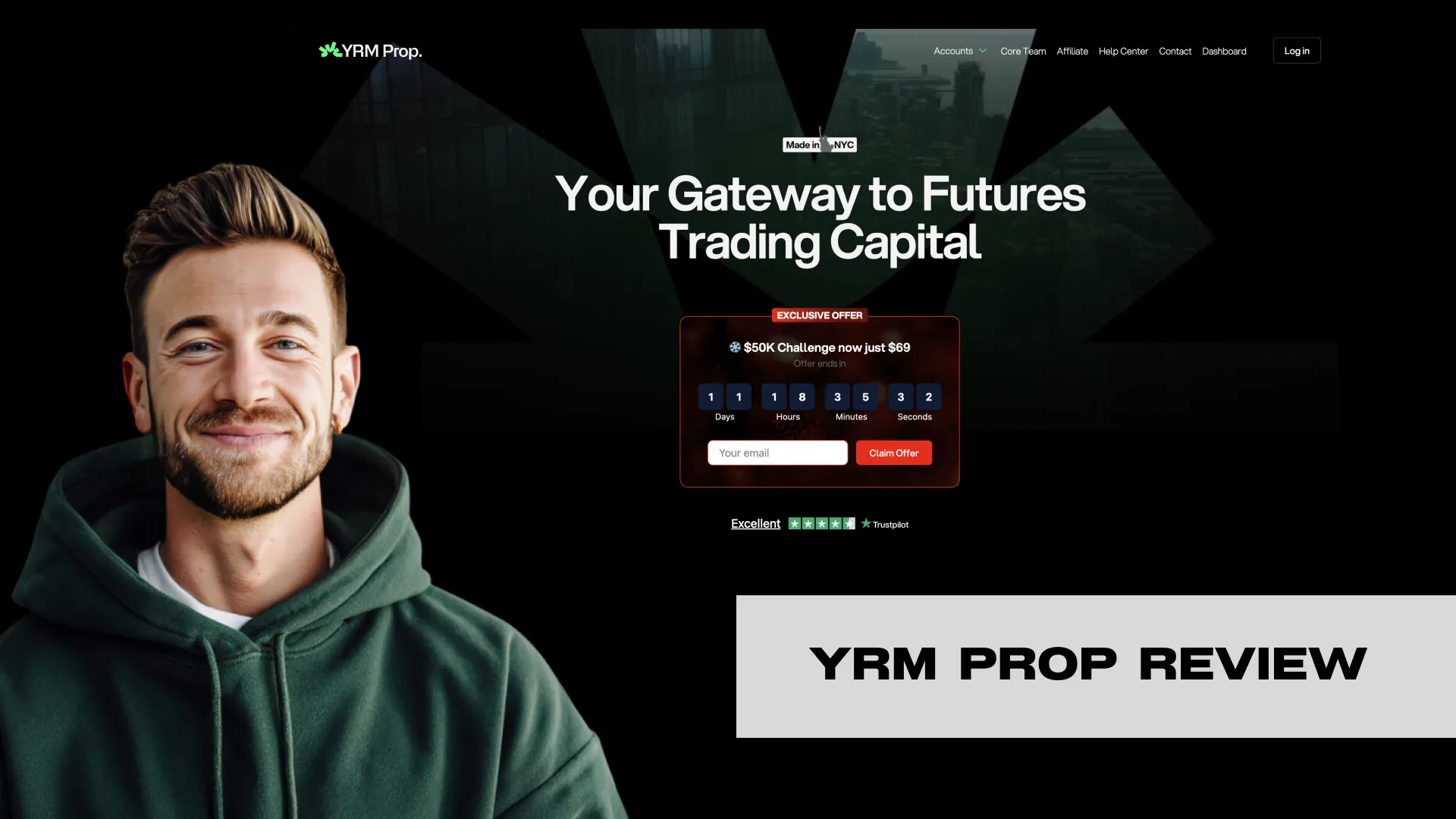
What is YRM Prop?
YRM Prop is a futures-only proprietary trading firm backed by Ocean-One Securities, a Bahamian broker-dealer. It offers three products on a one-time-fee basis: Starter Challenge (an evaluation with no payouts), Prime (funded, earned after passing Starter, 35 percent consistency), and Instant Prime (funded, purchased directly, 20 percent consistency). All accounts use a Trailing EOD drawdown that locks at the original starting balance once reached and a 90/10 profit split, with withdrawals processed through Rise. A Live Account stage transitions consistent traders into firm-allocated real capital.
YRM Prop Overview
YRM Prop is a U.S.-based futures proprietary trading firm running three distinct funded products plus a Live Account stage at the top. The firm is backed by Ocean-One Securities, a Bahamian broker-dealer, per its official Intercom Help Center documentation. YRM publicly launched in 2025 and operates on a one-time-fee structure across both Starter Challenge (evaluation) and Instant Prime (instant funded), differentiating from the monthly-subscription pricing model used by Alpha Futures, Tradeify, and most other 2026 futures props.
What sets YRM Prop apart in the 2026 futures prop firm landscape is the three-product architecture. Starter Challenge is the cheapest entry, a one-time-fee evaluation at $149 for $50K, $249 for $100K, $349 for $150K, with 50% consistency and no daily loss limit during evaluation. Pass the Starter and you earn a Prime funded account with 35% consistency, 6 qualifying days per payout cycle, and a 90/10 split. Instant Prime skips the evaluation entirely, purchased directly at $399 to $899 across four sizes, with 20% consistency, 8 qualifying days per cycle, and tighter contract limits. At the top sits the Live Account stage, where Risk Management transitions traders to firm-allocated real capital after payout milestones, with 90/10 split on the first $10,000 cumulative withdrawn and 80/20 thereafter.
A material rule change took effect on February 1, 2026. Old Prime and old Instant Prime accounts (funded or purchased before that date) run on the original flat-cap payout structure. New Prime accounts cap each cycle at the lower of the cap-table value or 50% of cycle profit. New Instant Prime accounts also require profit targets before each payout. The grandfathering matters, and most YRM cluster articles handle the old-vs-new split explicitly because the difference reshapes payout planning.
I've been trading YRM Prop since 2025. I've passed two Starter Challenge $50K evaluations, taken those accounts through to Prime, and completed multiple first-payout cycles via the Rise rail. Every cycle cleared without friction once KYC was completed. My personal experience covers the grandfathered Prime structure on the $50K size only; for Instant Prime, $100K/$150K Starter, the post-Feb-1 New Prime structure, and the Live Account stage, I rely on YRM's published Help Center documentation rather than personal trading. This review covers every dimension, pricing, rules, payouts, platforms, trust signals, and how YRM compares to the other futures prop firms I've tested. All data accurate as of April 2026.
Pros and Cons of YRM Prop
Pros
- One-time-fee pricing across Starter Challenge and Instant Prime, no monthly subscription to keep alive
- Trailing EOD drawdown that locks at the starting balance once reached, more forgiving than intraday trailing
- News trading fully allowed and VPN/VPS permitted (monitored) since the February 2026 update
- Five platforms supported: Volumetrica, Quantower, ATAS, Tradesea (YRM-native, launched May 19 2026), and Deepchart/Deepdom
- 90/10 profit split on simulated funded accounts, with a Live Account stage for firm-allocated real capital
- Withdrawals processed through Rise, with a low 250 dollar minimum on a single account
- Backed by Ocean-One Securities, a Bahamian broker-dealer, per the official Help Center
- Discount code VIBES unlocks 55 percent off all account types
Cons
- The February 1, 2026 grandfathering matters: old and new payout caps differ, and post-Feb-1 accounts carry tighter terms
- Post-Feb-1 Instant Prime adds profit targets, and new Prime applies a 50 percent per-cycle cap plus lower 4th-and-later payout caps
- Withdrawals are Rise only, with no alternative payout method
- A 100 dollar buffer must remain in the account after every payout
- Younger firm with a smaller Trustpilot footprint (4.6/5 across about 153 reviews) than long-established peers
YRM Prop Quick Reference
| Firm type | Futures-only prop firm, backed by Ocean-One Securities |
|---|---|
| Products | Starter Challenge, Prime, Instant Prime, Live Account |
| Pricing | One-time fee on Starter Challenge and Instant Prime |
| Profit split | 90/10 on simulated funded; Live Account 90/10 first $10K then 80/20 |
| Drawdown | Trailing EOD, locks at starting balance ($50K $2K, $100K $3K, $150K $4.5K) |
| Consistency rule | Prime 35%, Instant Prime 20% |
| Payout cadence | Prime 6 days, Instant Prime 8 days minimum |
| Withdrawals | Rise only; min $250 single account, $100 buffer after each payout |
| Platforms | Deepchart, Volumetrica, ATAS, Tradesea, Quantower |
| News and VPN | News trading allowed; VPN/VPS permitted (monitored) |
| Restricted countries | 19 plus restricted regions (full list on this page) |
| Trustpilot | 4.6/5 across about 153 reviews |
YRM Prop Account Types and Pricing
10 account types available.
| Plan | Price (VIBES) | Cycle | DLL | Split | Paul-tested |
|---|---|---|---|---|---|
| Starter $50K | $74.5$149 | 2-day | None | 80/20 → 90/10 | ✓ Yes |
| Prime $50K | $145 | 6-day | None | 80/20 → 90/10 | ✓ Yes |
| Instant Prime $50K | $299.5$599 | 8-day | None | 90/10 flat | No |
| Prime $100K | $245 | 6-day | None | 80/20 → 90/10 | No |
| Starter $25K | $49.5$99 | — | None | — | No |
| Starter $100K | $124.5$249 | — | None | — | No |
| Starter $150K | $174.5$349 | — | None | — | No |
| Instant Prime $25K | $199.5$399 | — | None | — | No |
| Instant Prime $100K | $374.5$749 | — | None | — | No |
| Instant Prime $150K | $449.5$899 | — | None | — | No |
Starter Challenge, one-time-fee evaluation
The Starter Challenge is YRM's evaluation product. Pass it and you earn a Prime funded account. The fee is one-time, paid at purchase, with no monthly subscription. Three sizes available:
| Size | Entry fee | Profit target | Trailing drawdown (EOD) | Daily loss limit | Min days | Consistency | Max contracts |
|---|---|---|---|---|---|---|---|
| $50K | $149 | $3,000 | $2,000 | None | 2 | 50% | 5 minis / 50 micros |
| $100K | $249 | $6,000 | $3,000 | None | 2 | 50% | 10 minis / 100 micros |
| $150K | $349 | $4,500 | $4,500 | None | 2 | 50% | 15 minis / 150 micros |
Drawdown is Trailing EOD on every Starter size, the floor moves with end-of-day balance and locks permanently at starting balance once profits push it there. There is no daily loss limit on Starter Challenge. Activation fee on the funded account post-pass is $99, currently waived as of April 2026. Resets are not currently available, a breached Starter requires a fresh purchase.
I've passed two $50K Starter Challenges personally. The $100K and $150K specs come from YRM's official Help Center documentation. For a deeper rule-by-rule walkthrough see the YRM Prop Starter Challenge rules guide.
Prime, earned, not purchased
Prime is the funded simulated account you receive after passing a Starter Challenge. There is no $25K Prime tier, Prime is only available at the size you passed your Starter at ($50K, $100K, or $150K). Specs:
| Size | Trailing drawdown (EOD, Hard) | Soft daily loss | Consistency | Min qualifying days/cycle | Profit target | Profit split |
|---|---|---|---|---|---|---|
| $50K | $2,000 | $2,000 | 35% | 6 | None | 90/10 |
| $100K | $3,000 | $3,000 | 35% | 6 | None | 90/10 |
| $150K | $4,500 | $4,500 | 35% | 6 | None | 90/10 |
A qualifying day = at least one executed trade and a session close with $150+ net profit. Days do not need to be consecutive. The cycle counter resets after every payout. Soft daily loss breach pauses trading for the rest of that day; the account stays active. Hard breach happens if live equity drops below the trailing floor at any point intraday.
The YRM Prop Prime rules guide covers the funded mechanics in depth.
Instant Prime, purchased directly, no challenge
Instant Prime skips the evaluation entirely. You purchase at one of four sizes and start on funded simulated capital immediately. The trade-off is a tighter consistency rule (20%) and more qualifying days per cycle (8). Specs:
| Size | One-time fee | Trailing drawdown (EOD) | Soft daily loss | Max contracts | Consistency | Min days/cycle |
|---|---|---|---|---|---|---|
| $25K | $399 | $1,250 | None | 1 mini / 10 micros | 20% | 8 |
| $50K | $599 | $2,000 | $1,500 | 2 minis / 20 micros | 20% | 8 |
| $100K | $749 | $4,000 | $3,000 | 4 minis / 40 micros | 20% | 8 |
| $150K | $899 | $6,000 | $4,500 | 7 minis / 70 micros | 20% | 8 |
Profit split is 90/10 from day one, identical to Prime. Activation fee $99 currently waived. Drawdown is Trailing EOD locking at starting balance, identical mechanic to Starter and Prime. New Instant Prime accounts (purchased Feb 1, 2026 onward) require profit targets before each payout (see Live Account and payouts below). The YRM Prop Instant Prime rules guide covers the full ruleset.
Plan comparison at a glance
| Feature | Starter Challenge | Prime (earned) | Instant Prime (purchased) |
|---|---|---|---|
| Sizes available | $50K / $100K / $150K | $50K / $100K / $150K | $25K / $50K / $100K / $150K |
| Pricing | $149 / $249 / $349 one-time | Earned via Starter pass | $399 / $599 / $749 / $899 one-time |
| Evaluation required | Yes | n/a (already funded) | No |
| Drawdown type | Trailing EOD | Trailing EOD | Trailing EOD |
| Daily loss limit | None | Soft (Prime sizes) | None on $25K, soft $50K+ |
| Consistency rule | 50% | 35% | 20% |
| Min trading days | 2 (to pass eval) | 6 per payout cycle | 8 per payout cycle |
| Profit target | Yes (eval phase) | None | Required on post-Feb-1 accounts |
| Profit split | n/a (eval, no payouts) | 90/10 | 90/10 |
| Max contracts | Up to 15 minis on $150K | Up to 15 minis on $150K | Up to 7 minis on $150K |
| Resets | Not currently available | n/a | n/a |
| News trading allowed | Yes | Yes | Yes |
A maximum of three combined funded accounts (Prime + Instant Prime) can run simultaneously per trader. Detailed account-size comparison lives in the YRM Prop account sizes guide; the full account architecture sits in the YRM Prop accounts overview.
Live Account stage, top-of-funnel real capital
The Live Account is not purchasable. Risk Management calls eligible traders to Live after their simulated funded payouts accumulate, most commonly after the 4th payout, possible from the 2nd. The transition is mandatory. Forced transition kicks in at lifetime payout caps:
| Account size | Lifetime payout cap before forced Live |
|---|---|
| $25K Instant Prime | $35,000 |
| $50K Prime / Instant Prime | $50,000 |
| $100K Prime / Instant Prime | $75,000 |
| $150K Prime / Instant Prime | $85,000 |
Caps are combined across multiple accounts of same or different sizes. At Live transition, 16% of each contributing simulated account's balance moves to Live and consolidates into one Live account ($4,000 from $25K, $8,000 from $50K, $16,000 from $100K, $24,000 from $150K). Pending simulated payouts are canceled. Live profit split is 90/10 on the first $10,000 cumulative withdrawn, then 80/20 thereafter. After 30 days in Live, Risk Management may discretionarily increase the capital allocation based on demonstrated trading discipline. Full mechanics in the YRM Prop Live Account rules guide.
Who YRM Prop Is For (And Who It Isn't)
Match yourself to YRM Prop's structure before signing up. Based on the 10 account types, drawdown mechanic, and Paul's testing data.
- ·Traders who want their starting capital protected after the lock event
- ·Swing or position styles holding through close
- ·Aggressive sizers — at least one plan has no consistency rule on funded
- ·Traders allergic to daily loss limits — at least one plan has no DLL
- ·Cash-velocity seekers — fast payout cycles available
Plan Economics: What Each YRM Prop Account Actually Costs You
The headline price isn't the full picture. Here's the per-account math — buying-power cost, risk buffer, and breakeven estimate based on standard 30%-buffer-utilization assumptions.
| Plan | Buy-in | Risk buffer | Cost per $1K BP | Breakeven* |
|---|---|---|---|---|
| Starter $50K | $74.5VIBES | $2,000 | $1.49 | ~1 cycles |
| Prime $50K | $145 | $2,000 | $2.90 | ~1 cycles |
| Instant Prime $50K | $299.5VIBES | $2,000 | $5.99 | ~1 cycles |
| Prime $100K | $245 | $4,000 | $2.45 | ~1 cycles |
| Starter $25K | $49.5VIBES | — | $1.98 | — |
| Starter $100K | $124.5VIBES | — | $1.25 | — |
| Starter $150K | $174.5VIBES | — | $1.16 | — |
| Instant Prime $25K | $199.5VIBES | — | $7.98 | — |
| Instant Prime $100K | $374.5VIBES | — | $3.75 | — |
| Instant Prime $150K | $449.5VIBES | — | $3.00 | — |
How to read this:
- Buy-in = price you pay to start the evaluation (with PTV code applied where available).
- Risk buffer = dollars between your starting balance and the Maximum Loss Limit — the absolute drawdown room before breach.
- Cost per $1K buying power = price ÷ starting balance × $1,000. Lower = cheaper leverage. Useful to compare account sizes within the firm and across firms.
- Breakeven estimate* = approximate number of payout cycles to recoup your buy-in, assuming you utilize 30% of your risk buffer profitably per cycle at the plan's profit split. This is a baseline expectation, not a guarantee — your actual cycle output depends on strategy and discipline.
*Breakeven uses a standard 30%-buffer-utilization-per-cycle assumption. Aggressive sizing can shorten breakeven (and increase breach risk); conservative sizing extends it.
Sweet spot for new users: Starter $25K at $49.5 is the cheapest entry to learn YRM Prop's rules without risking a larger buy-in. If you're already confident in your strategy, sizing up to Starter $50K typically improves your cost-per-$1K-buying-power ratio.
My Experience with YRM Prop
Two Starter Challenges, four payouts, around $6,000 via Rise
I started trading YRM Prop in 2025, bought two Starter Challenge $50K accounts at $149 each, passed both evaluations, and ran them through to Prime. I have completed multiple payout cycles via Rise across those accounts. The first cycle on each fell under the grandfathered first-payout cap (the rule that applied to Prime accounts funded before the February 1, 2026 change), and the later cycles were follow-ups on the same accounts.
Why the Starter Challenge worked for me. The 50% consistency rule on Starter Challenge gave me real flexibility to take a couple of larger days early in the evaluation as long as I traded enough additional smaller days to dilute the concentration ratio before the profit target. The absence of a daily loss limit on Starter is the single rule that reshapes how I size on evaluation: I can hold through an adverse intraday move without the day-ender mechanic that traditional evaluations use, as long as I respect the trailing drawdown floor at the session close. The two-day minimum trading-days requirement is straightforward, a focused trader can pass the $50K target in a single trading week if the setup cooperates.
The Trailing EOD drawdown locks at starting balance. This is the rule I plan around most. Once profits push the trailing floor up to match the starting balance, the floor locks permanently. Every dollar above starting balance from that point is cushion that cannot be eroded by future drawdown. On both my $50K Prime accounts I aimed to push the floor to lock as quickly as possible, then traded with a wider risk envelope from there.
The Prime payout rhythm fits the Rise rail. Prime requires 6 qualifying days per cycle (a qualifying day = at least one trade plus $150+ net profit close). On the grandfathered $50K Prime structure, the first cycle pays at the $1,500 cap, second at $2,000, third at $2,500, and 4th onward at $4,000. I completed multiple first-payout cycles via Rise, with follow-up cycles settling on the same accounts after that. Withdrawal mechanics: submit the request, payout approved within the firm's documented window, Rise routes it from there. KYC took about a day at first payout (gov-issued ID plus selfie via Riseworks). After that, every subsequent withdrawal request cleared without friction.
What hasn't worked. The Starter Challenge doesn't currently offer resets. I've been disciplined about position sizing on every Starter run, but if a trader does breach, the only path is buying a new Starter at full price. Plan accordingly. The other constraint I've watched is the consistency rule when I'm tempted to size up on a clean setup, it's tempting to take outsized risk on a strong day and then trade flat the rest of the cycle, but the 35% rule on Prime catches that pattern. The workaround is simple: trade enough additional smaller days to dilute the concentration ratio before requesting the payout.
What I haven't tested personally. Instant Prime (any size), $100K and $150K Starter Challenges, the Live Account stage, and the post-February-1, 2026 New Prime payout structure. Those facts in this review come from YRM's official Help Center documentation, not my account history. The grandfathered Prime structure I'm running was the rule set in place when I funded these accounts, so my payout-cycle experience reflects the older flat-cap table rather than the newer 50%-of-cycle-profit cap.
Net read after two passed evaluations and four payouts. YRM Prop's one-time-fee Starter is the best entry pricing I've found in the 2026 futures prop space for traders confident they can pass within a single attempt. The Trailing EOD drawdown locking at starting balance is structurally favorable. The Rise payout rail clears withdrawals reliably once KYC is completed. The product split (Starter vs Prime vs Instant Prime) demands attention to which consistency rule applies to which account, but once you internalize the framework it works as documented. Both of those Old Prime accounts have since closed and YRM is currently dormant in my rotation, but the testing data above stands.
The bottom line
YRM Prop is a structurally interesting futures prop firm in 2026, one-time-fee Starter pricing at $149 to $349, Trailing EOD drawdown that locks at starting balance, no daily loss limit on Starter Challenge, 90/10 split on every simulated funded account from day one, three documented products covering distinct trader profiles, and a Live Account stage that transitions traders to firm-allocated real capital after payout milestones. The Rise-only payout rail and the post-Feb-1 grandfathering split between Old and New Prime are real frictions, and the four-platform stack (Volumetrica, Quantower, ATAS, Tradesea) excludes traders coming from NinjaTrader or Tradovate. But for traders who want one-time-fee evaluation pricing, a forgiving evaluation rule set, and a documented progression path from simulated to live, YRM Prop earns a place in the 2026 rotation. Sign up at the YRM Prop affiliate page for the current pricing and any active promotional codes.
How YRM Prop Drawdown Works
EOD · Locks up-onlyYRM Prop runs the most-forgiving mechanic in the prop industry. Your Maximum Loss Limit (MLL) starts at $2,000 below your starting balance and trails UP only at end-of-day close. Once it reaches your starting balance, it locks there permanently.
How YRM Prop's mechanic works in practice
- Intraday equity drops do NOT move the MLL — only end-of-day close matters.
- After every profitable EOD close, the MLL ratchets up by the profit increment.
- Once MLL = starting balance: lock engaged. From this point, only a daily-loss-limit breach or a full wipe to starting balance can break the account.
- After lock, you can ride a drawdown back to starting balance without breaching — your starting capital is permanently protected.
Best fit
Best for swing traders, position holders, and anyone who values starting-capital protection. The mechanic forgives intraday volatility and rewards traders who close cleanly each day.
What to watch out for
- Pre-lock state is more fragile than headline numbers suggest — the trail can catch you mid-cycle if you size aggressively.
- A single bad close before lock can move the MLL above starting balance, making the next intraday dip lethal.
- Reaching the lock requires consistent EOD profitable days — choppy markets delay it.
How YRM Prop Payouts Actually Work
Payout cycle ranges from 2 to 8 days depending on plan. 1 payout method supported.
Cycle requirements per plan
- Starter $50K — minimum 2 days between payouts on funded.
- Prime $50K — minimum 6 days between payouts on funded.
- Instant Prime $50K — minimum 8 days between payouts on funded.
- Prime $100K — minimum 6 days between payouts on funded.
Payout method comparison
| Method | Fees | Speed | When to use |
|---|---|---|---|
| Rise | Free for traders | Same-day after request | Tradeify-class platform — 7 days/week processing. |
Practical takeaway: YRM Prop's cycle length means you can realistically expect ~15 payouts per month on a profitable funded account. The actual processing time after request varies by method — pick the option that matches your residency and crypto-comfort.
YRM Prop Trading Rules
Trailing EOD drawdown, the rule that defines YRM
Every YRM product (Starter, Prime, Instant Prime) uses Trailing EOD drawdown. The mechanic:
- Drawdown floor starts at a fixed dollar amount below the starting balance (e.g., $50K Starter starts the floor at $48,000, $2,000 below starting).
- The floor trails the highest end-of-day balance upward at session close, never intraday.
- Once profits push the floor up to match the starting balance, the floor locks permanently and never moves again.
- Hard breach happens if live equity drops below the trailing floor at any point intraday → account closes immediately, profits forfeit.
Worked example on $50K Starter: starting balance $50,000, starting floor $48,000. Close day one at $52,000 → floor moves to $50,000 (starting balance) and locks. From day two forward, the floor is a static $50,000 floor regardless of how high the account balance grows. Every dollar above $50,000 is pure cushion.
For a deeper drawdown breakdown including how Trailing EOD compares to fixed-floor and intraday-trailing alternatives, see the YRM Prop drawdown type explained.
Daily loss limits, soft, not account-ending
Soft daily loss limits exist on Prime (all sizes) and Instant Prime $50K and above. When the soft limit is breached, trading is paused for the rest of the day. The account stays active and trading resumes the next session. Soft daily loss does NOT auto-deny the payout cycle, it is a day-ender, not a cycle-ender.
| Product / size | Soft daily loss limit |
|---|---|
| Starter Challenge (any size) | None |
| Prime $50K | $2,000 |
| Prime $100K | $3,000 |
| Prime $150K | $4,500 |
| Instant Prime $25K | None |
| Instant Prime $50K | $1,500 |
| Instant Prime $100K | $3,000 |
| Instant Prime $150K | $4,500 |
There is no daily loss limit on the Starter Challenge or on $25K Instant Prime, those are the two sizes where intraday drawdown is bounded only by the trailing floor.
Consistency rules, three different limits across three products
| Product | Concentration limit | Min qualifying days |
|---|---|---|
| Starter Challenge | 50% | 2 (to pass evaluation) |
| Prime (funded) | 35% | 6 (per payout cycle) |
| Instant Prime (funded) | 20% | 8 (per payout cycle) |
Concentration formula: highest single-day profit divided by total cycle profit must be at or below the allowed percentage. Concentrated styles get filtered. Workaround on Prime and Instant Prime: trade additional smaller qualifying days to dilute the concentration ratio before requesting the payout. Full breakdown in the YRM Prop consistency rules guide.
News trading rule
News trading is fully allowed across all YRM products since February 1, 2026. Open positions during high-impact releases, hold through them, trade the volatility freely. The only news-related prohibition is manipulative news straddling, paired buy/sell entries designed to trap volatility regardless of direction. Earlier YRM rules required a 2-minute buffer; that buffer was retired. The YRM Prop news trading policy covers the rule in detail.
VPN / VPS, allowed but monitored
VPN and VPS connections are not banned at YRM. Traders use them for travel, privacy, and connection stability. The risk team flags patterns suggesting abuse, location hopping between regions, simultaneous regional logins, multi-user access on one account, for review. Stable VPN use from a consistent geography does not get accounts disqualified. Full policy in the YRM Prop VPN policy guide.
Hedging and copy trading
- Hedging across YRM accounts (long + short same instrument simultaneously across two YRM accounts): prohibited.
- Cross-firm hedging (long on YRM, short elsewhere): prohibited.
- Different strategies on different instruments across accounts: allowed.
- Internal copy trading (YRM's native copy tools): allowed.
- External trade copiers managing your own YRM accounts: allowed.
- Same strategy across multiple YRM accounts: allowed.
- Risk-neutralization or coordinated multi-person trading: prohibited.
The YRM Prop copy trading rules covers the multi-account framework.
Prohibited strategies
- High-frequency trading patterns (sub-second placement and cancellation)
- Tick-scalping as a sustained pattern
- Spoofing and layering
- Latency-driven execution arbitrage
- Account sharing (one account, multiple physical traders)
Manual discretionary trading is always permitted, even at high frequency from a single human trader. The full rules pillar is the YRM Prop rules overview.
Maximum contracts by product and size
The contract ceiling differs significantly between Starter/Prime and Instant Prime. Detailed table in the YRM Prop maximum contracts guide:
| Size | Starter / Prime | Instant Prime |
|---|---|---|
| $25K | n/a (no $25K Starter/Prime) | 1 mini / 10 micros |
| $50K | 5 minis / 50 micros | 2 minis / 20 micros |
| $100K | 10 minis / 100 micros | 4 minis / 40 micros |
| $150K | 15 minis / 150 micros | 7 minis / 70 micros |
Withdrawal rail (Rise only)
YRM Prop withdrawals route exclusively through Rise (riseworks.io). No ACH, no Wire, no Wise, no PayPal alternatives. KYC is required once before the first payout, completed via the Rise platform (gov-issued ID plus selfie verification, typically clears within a day). After KYC is completed, every subsequent payout uses the same Rise account.
General payout rules (all funded products)
- Min payout request: $250 for a single-account withdrawal; $500 per account when withdrawing across multiple accounts in one batched request.
- $100 buffer rule: every payout must leave at least $100 in the account.
- Cycle reset: the qualifying-day counter resets to zero after every payout request.
- Profit split: 90/10 trader/firm on every simulated funded account.
Prime payout caps, old vs new (Feb 1, 2026 grandfathering)
A material rule change took effect on February 1, 2026. Prime accounts funded before that date are grandfathered onto the original flat-cap table. Prime accounts funded on or after Feb 1, 2026 run on the New Prime structure with a 50%-of-cycle-profit cap on top of the cap-table value.
Old Prime (funded before Feb 1, 2026), grandfathered flat caps
| Size | 1st payout | 2nd payout | 3rd payout | 4th+ payout |
|---|---|---|---|---|
| $50K | $1,500 | $2,000 | $2,500 | $4,000 |
| $100K | $2,000 | $2,500 | $3,000 | $5,000 |
| $150K | $2,500 | $3,000 | $3,500 | $6,000 |
I've personally cycled four times on this grandfathered Old Prime structure on $50K accounts at the $1,500 first-payout cap. Rules: 6 qualifying days per cycle, 35% consistency, no profit target, $100 buffer.
New Prime (funded on or after Feb 1, 2026), 50%-of-cycle-profit cap
| Size | 1st payout | 2nd payout | 3rd payout | 4th+ payout |
|---|---|---|---|---|
| $50K | $1,500 | $2,000 | $2,500 | $2,750 |
| $100K | $2,000 | $2,750 | $3,250 | $3,750 |
| $150K | $2,500 | $3,250 | $3,750 | $4,250 |
Each cycle pays out the lower of the cap-table value OR 50% of the trader's cycle profit. Rules otherwise match Old Prime: 6 qualifying days, 35% consistency, $100 buffer, no profit target. The 50%-of-cycle-profit cap forces traders to accumulate more cycle profit to reach the same payout amounts as grandfathered traders.
Instant Prime payout caps, old vs new
Old Instant Prime (purchased before Feb 1, 2026)
| Size | 1st payout | 2nd payout | 3rd payout | 4th+ payout |
|---|---|---|---|---|
| $25K | $1,000 | $1,500 | $2,500 | $3,500 |
| $50K | $1,500 | $2,000 | $2,500 | $4,000 |
| $100K | $2,000 | $2,500 | $3,000 | $5,000 |
| $150K | $2,500 | $3,000 | $3,500 | $6,000 |
Rules: 8 qualifying days per cycle, 20% consistency, no profit target, $100 buffer.
New Instant Prime (purchased Feb 1, 2026 onward)
| Size | Payouts 1–3 | 4th+ payout |
|---|---|---|
| $25K | $1,000 | $1,250 |
| $50K | $2,000 | $2,500 |
| $100K | $2,500 | $3,000 |
| $150K | $3,000 | $3,500 |
Rules: 8 days, 20% consistency, profit target required before each payout (table below), $100 buffer.
New Instant Prime profit targets (post-Feb-1, 2026 accounts only)
| Size | First payout target | Subsequent payout targets |
|---|---|---|
| $25K | $1,500 | $1,000 |
| $50K | $3,000 | $2,000 |
| $100K | $5,000 | $3,500 |
| $150K | $8,000 | $5,000 |
The profit-target requirement is the major new-account-only friction. Older Instant Prime accounts have no profit target, a trader could request the first payout the moment 8 qualifying days were on the books regardless of cumulative cycle profit.
For a deeper payout-mechanics walkthrough, see the YRM Prop payout rules and payout proof articles.
Live Account profit split
After Live transition, the split shifts from 90/10 to:
- First $10,000 cumulative withdrawn from Live: 90/10 trader/firm
- Beyond $10,000: 80/20
Live withdrawals also route via Rise. The 30-day discretionary capital review by Risk Management can increase allocation based on trading discipline.
Strategies and Best Practice
Strategy framework at YRM Prop
The YRM rule framework favors disciplined day traders with clean session-close discipline and respect for the consistency rule that applies to their product. Position sizing must respect the trailing drawdown floor on every account; consistency-rule planning must respect the 50% / 35% / 20% limits across Starter / Prime / Instant Prime. Full strategy playbook in the YRM Prop trading strategies guide.
Product-specific strategy implications
Starter Challenge. The 50% consistency rule and lack of a daily loss limit make Starter the most flexible YRM evaluation environment. Traders can hold through adverse intraday moves as long as the session close respects the trailing floor. The two-day minimum keeps the evaluation fast, focused traders can pass $50K within a single trading week if the setups cooperate. The trade-off: no resets currently available, so a breached Starter requires a fresh purchase.
Prime. The 35% consistency rule on Prime catches concentrated edge. Traders whose system produces a few outsized days per cycle need to trade enough additional smaller qualifying days to dilute the ratio. The Soft daily loss limit on Prime ($2K / $3K / $4.5K by size) is a day-ender, not a cycle-ender, bad days don't disqualify the payout cycle on their own as long as the trailing floor stays intact.
Instant Prime. The 20% consistency rule is the tightest in the YRM stack. Concentrated trading styles will struggle on Instant Prime, the rule essentially demands distributed profit across at least 5 trading days within a cycle. Combine that with the 8-qualifying-day minimum (vs Prime's 6) and the profit-target requirement on post-Feb-1 accounts, and Instant Prime fits a steady-incremental trader profile better than a concentrated-edge trader.
Using the Trailing EOD drawdown lock as an edge
The drawdown locking at starting balance is the rule I plan around most. Once profits push the floor up to lock at starting balance, every dollar above starting balance is pure cushion that cannot be eroded by future drawdown. Practical implication: push the lock as quickly as is responsible (trade enough small winning days to push the floor without violating consistency), then trade with a wider risk envelope from there. Detailed mechanic in the YRM Prop drawdown comparison.
News trading at YRM (post-Feb-1, 2026)
Since February 1, 2026, news trading is fully allowed on every YRM product. CPI, FOMC, NFP, GDP, ECB rate decisions, all tradeable, no buffer windows. The only prohibition is manipulative news straddling. For the news-trading playbook see the YRM Prop news trading strategy.
Scalping and swing trading on YRM
Manual scalping is fully permitted within the contract limits and the prohibition on sub-second placement-and-cancellation patterns. Swing trading is permitted; intraday position holds across multiple sessions are subject to the trailing drawdown mechanic at each EOD close. See the YRM Prop scalping playbook and YRM Prop swing trading playbook for product-specific tactics.
Multi-account strategy
Maximum three combined funded accounts (Prime + Instant Prime). Mixing makes sense for traders who want different rule frameworks on different accounts, for example, a $50K Prime for steady-cycle base trading plus a $25K Instant Prime for higher-frequency setups. Hedging across accounts is prohibited; copy trading is allowed. The Live Account stage forces all eligible simulated accounts to merge into one Live account at transition, so multi-account scaling is meaningful only during the simulated phase.
YRM Prop Platforms
Five supported platforms (May 2026)
YRM Prop officially supports five trading platforms. NinjaTrader, Tradovate, TradingView, MetaTrader, ProjectX, and TopstepX are NOT supported. The complete list:
- Volumetrica, YRM's primary platform. Web-based and mobile, with advanced charts and real-time data feeds. The simplest entry point, most new YRM traders start on Volumetrica because no desktop install is required. Full setup walkthrough in the Volumetrica platform guide.
- Quantower, desktop application, multi-OS (Windows + Mac + Linux). Multi-market platform with low-latency execution and a large indicator library. The pick for traders who want desktop-native power-user tooling. Setup in the Quantower platform guide.
- ATAS, desktop application, order-flow and footprint focused. Volume profile, cluster charts, footprint visualizations. The niche pick for order-flow-focused futures traders who want the same toolkit they use on personal accounts. Setup in the ATAS platform guide.
Tradesea, YRM Prop's own web-based platform launched May 19, 2026 at tradesea.ai. Three trading modes (Scalp Mode for fast execution with a floating trade pad, DOM Mode for ladder trading and order-flow execution, and Order Mode for structured entries with predefined stop-loss and risk-to-reward planning). Built-in Copy Trading supports lead and follower accounts under Settings → Copy Trading. Personal Daily Loss Limit (PDLL), Personal Daily Profit Target (PDPT), and Personal Lockouts give traders revenge-trading guardrails baked into the platform itself. Connects via YRM Prop Rithmic credentials (not the YRM website dashboard login and not dxFeed credentials). Only available to YRM Prop account holders who select Tradesea at checkout.
Deepchart (Deepdom), the YRM-supported charting and trading stack covering futures order-flow analysis alongside execution. The pick for traders who want a YRM-native charting experience without the third-party platform install. Setup details are in YRM's Deepchart platform guide.
I've personally configured Volumetrica and Quantower on live YRM accounts. ATAS, Tradesea, and Deepchart specifics in this review come from YRM's published platform documentation rather than personal account setup.
Which platform to pick
Volumetrica is the right choice for most new YRM traders, no install, web access, mobile companion, real-time charts, fast onboarding. Quantower is the right choice for serious day traders who want a multi-OS desktop platform with deep indicator support and low-latency routing. ATAS is the right choice for order-flow scalpers and volume-profile traders who already use ATAS on personal capital.
Platform selection happens at account configuration after purchase. The full platforms pillar is the YRM Prop trading platforms guide.
Trust and Legitimacy
Corporate structure
YRM Prop is a U.S.-based prop trading firm. According to the firm's official Intercom Help Center documentation, YRM Prop is backed by Ocean-One Securities, a Bahamian broker-dealer that provides the corporate backing for the firm's funding programs. The firm publicly launched in 2025 and operates a documented Help Center at `intercom.help/yrmprop/en/` covering 37+ articles spanning rules, payouts, account types, and platform setup. Detailed company information lives in the YRM Prop company info guide.
The exact legal incorporation date and registered entity name are not stated in the firm's public-facing Help Center as of April 2026, traders who need that level of corporate-registry detail should reach out via support@yrmprop.com.
Trustpilot signals
Trustpilot rating and review count for YRM Prop are tracked on the live Trustpilot page. Public review aggregation sources can be slow to update for newer firms; the YRM Prop Trustpilot reviews analysis covers the live signal. The is YRM Prop legit and YRM Prop vs scam firms articles cover the broader trust assessment.
Payout proof
I've documented multiple first-payout cycles via Rise on the grandfathered Prime $50K structure. Each cleared via Rise after the standard approval window once KYC was completed. The YRM Prop payout proof guide covers the documentation in depth.
KYC and identity verification
KYC is required once, before the first payout, completed via Rise (riseworks.io). Gov-issued photo ID plus a selfie for identity matching. Verification typically clears within a day. KYC is NOT required at signup, traders can buy, evaluate, pass, and run multiple qualifying days before completing KYC at the moment of first payout request.
Restricted countries
YRM Prop restricts 19 countries as of April 2026: Afghanistan, Central African Republic, Congo (Brazzaville), Congo (Kinshasa), Cuba, Guinea-Bissau, Iran, Iraq, North Korea, Libya, Mali, Russian Federation, Somalia, South Sudan, Sudan, Syria, Tunisia, Venezuela, Yemen. Citizens of restricted countries who reside permanently in eligible countries can apply via support@yrmprop.com on a case-by-case basis. Full breakdown in the YRM Prop restricted countries guide.
Who Is Behind YRM Prop?
YRM Prop is the venture of Mohamed "Moe" Saidi (CEO and co-founder) and Alexander Shapiro (co-founder), launched as a New York-based operation in 2025. The team pushed an aggressive payout cadence and the early Trustpilot signal is positive. The honest caveat is age: this is a 2025 firm with no multi-year track record and no record through a full market cycle, so I weight that stability risk in the rating. What I can stand behind is my own record , I ran two Old Prime $50K accounts through to recurring payouts via Rise across four cycles before going inactive.
How YRM Prop Compares
YRM Prop vs Lucid Trading
Lucid uses one-time evaluation fees and an EOD trailing drawdown that locks at the starting balance, very close to YRM mechanically. YRM counters with a broader product ladder (Starter, Prime, Instant Prime, Live) and a 55 percent discount.
Both are one-time-fee, EOD-locking firms, so the choice comes down to product fit and payout terms. Lucid is the simpler, faster-payout single-mechanic option. YRM offers more paths to funding plus a Live Account stage, at the cost of more rule complexity around the February 2026 grandfathering.
YRM Prop vs Top One Futures
Top One Futures runs five account programs with sub-24-hour Riseworks payouts and a 90 percent split. YRM matches the 90/10 split and Rise withdrawals but layers a Starter to Prime progression and a Live Account stage on top.
TOF is the broader, faster-payout catalog. YRM is the progression-based firm where you earn Prime through Starter or buy Instant Prime, then can graduate to a Live Account. Both allow news trading; both use Rise.
YRM Prop vs MyFundedFutures
MyFundedFutures is a larger, more established firm with multiple plan families. YRM is younger but cheaper to enter with the 55 percent discount and offers a Live Account real-capital stage that MFFU structures differently.
MFFU wins on track record and brand volume. YRM competes on one-time-fee entry, the EOD-locking drawdown, and the Live Account progression. Confirm current consistency rules on both, since YRM varies it by product (35 percent Prime, 20 percent Instant Prime).
YRM Prop Deep Comparison
Head-to-head comparison table
| Feature | YRM Prop | Topstep | Tradeify | Take Profit Trader | TickTickTrader | Lucid Trading |
|---|---|---|---|---|---|---|
| Fee model | One-time fee (Starter + Instant Prime) | One-time fee | Monthly subscription | One-time fee | One-time fee | One-time fee |
| Drawdown type | Trailing EOD, locks at starting balance | Intraday trailing | Intraday trailing | Intraday trailing | Intraday trailing | Intraday trailing |
| Top profit split | 90% (every funded account) | 90% | 90% | 90% | 80-90% | 90% |
| Daily loss limit on evaluation | None on Starter | Yes | Yes | Yes | Yes | Yes |
| Instant-funded plan | Yes (Instant Prime) | No | No | No | No | No |
| Live-capital path | Yes (Live Account stage) | Funded Account | No public | No public | No public | No public |
| Payout rail | Rise only | Multiple | Multiple | Multiple | Multiple | Multiple |
| Max simultaneous accounts | 3 (Prime + Instant Prime) | Varies | Varies | Varies | Varies | Varies |
| Platforms supported | 3 (Volumetrica, Quantower, ATAS, Tradesea) | 4+ | 4+ | 3 | 3 | 3 |
| Years in operation | ~1 (launched 2025) | 12+ | ~2 | ~4 | ~3 | ~1 |
YRM Prop vs Topstep
Topstep is the incumbent (12+ years, large user base, mature payout infrastructure). YRM differentiates on three dimensions: one-time-fee Starter pricing vs Topstep's one-time Trading Combine fee structure that includes activation; Trailing EOD drawdown that locks at starting balance vs Topstep's intraday-trailing drawdown that can break on a wick; the documented Live Account stage at the top of the YRM funnel that Topstep does not publicly run as a separate product. Pick Topstep for brand recognition and the scale of their community; pick YRM for the locking trailing drawdown and the Live Account progression. Detailed comparison in YRM Prop vs Topstep.
YRM Prop vs Tradeify
Tradeify runs on monthly subscription pricing; YRM runs on one-time fees. Both use trailing drawdowns but with different mechanics, YRM locks at starting balance, Tradeify uses intraday trailing on most products. YRM has the Instant Prime path; Tradeify offers different rule variations. Pick Tradeify for traders whose strategy fits its specific rule framework and who prefer monthly-fee recurring evaluation; pick YRM for the one-time-fee certainty and the Live Account stage. See YRM Prop vs Tradeify.
YRM Prop vs My Funded Futures (MFF)
MFF and YRM both serve futures traders with one-time-fee structures. YRM's Trailing EOD drawdown locks permanently at starting balance once the floor reaches it; MFF uses different drawdown mechanics. YRM has the three-product structure (Starter / Prime / Instant Prime) plus the Live Account; MFF has its own product structure. Detailed feature-by-feature breakdown in YRM Prop vs My Funded Futures.
YRM Prop vs Take Profit Trader
Take Profit Trader uses intraday-trailing drawdown and a one-time fee model. YRM uses Trailing EOD locking at starting balance and one-time fees. Both offer 90% splits. TPT has a longer track record; YRM has the plan-variety advantage (Starter + Prime + Instant Prime + Live) and the locking-drawdown structural edge. Pick TPT for the mature operating history; pick YRM for the locking-drawdown and progression path. See YRM Prop vs Take Profit Trader.
YRM Prop vs Lucid Trading
Lucid Trading is a newer entry with one-time fees and intraday trailing. YRM has the locking-drawdown advantage and the Live Account stage. Lucid has its own niche product positioning, for traders comparing Lucid head-to-head with YRM, the YRM Prop vs Lucid Trading breakdown covers the full feature set.
YRM Prop vs TopOne Futures
TopOne Futures is another one-time-fee futures prop. YRM's locking trailing drawdown and the documented Live Account progression are the structural differentiators; TopOne has its own rule framework and payout cadence. Detailed comparison in YRM Prop vs TopOne Futures.
Broader alternatives
For traders evaluating multiple alternatives at once, the YRM Prop alternatives roundup covers the broader 2026 futures prop landscape.
Restricted Countries for YRM Prop
YRM Prop restricts traders from the following countries. The list reflects the firm's published eligibility policy at last review.
- Afghanistan
- Belarus
- Congo (Brazzaville)
- Congo (Kinshasa)
- Crimea
- Cuba
- Donetsk
- Guinea-Bissau
- Iran
- Iraq
- Libya
- Luhansk
- Mali
- North Korea
- Russia
- Somalia
- South Sudan
- Sudan
- Syria
- Tunisia
- Venezuela
- Yemen
Full breakdown including special-case territories: read the YRM Prop restricted countries guide.
YRM Prop FAQ
Is YRM Prop legit?
What are the YRM Prop products?
How does the YRM Prop drawdown work?
What is the YRM Prop consistency rule?
How do YRM Prop payouts work?
What platforms does YRM Prop support?
Can you trade news and use a VPN on YRM Prop?
What is the YRM Prop discount code?
The Bottom Line
After passing two Starter to Prime evaluations on the grandfathered $50K Old Prime structure and completing multiple payout cycles via Rise, YRM Prop earned a place in my 2026 rotation for the forgiving EOD-locking drawdown, the one-time-fee Starter pricing, and a Rise-only payout rail that cleared reliably once KYC was completed. Both Old Prime accounts have since closed and YRM is currently dormant for me, but the testing data above stands.
Methodology 2 Old Prime $50K · ~$6K · inactive · last tested May 2026
Every review on PTV comes from accounts I fund and trade with my own money. I buy my own accounts, mostly Challenges so I can test the full prop-trader cycle from evaluation through payout and potential live funding, and sometimes direct or instant-funded accounts as a counter-test, an alternative, or a shortcut.
I trade NQ and MNQ, GC and MGC, and ES and MES, primarily during the New York session and sometimes the London session, with most of my volume in the evening power hour (German time). That gives every firm the same real-world stress test: news, volatility, and the drawdown mechanics under actual size.
I tested YRM by passing two Starter Challenge $50K evaluations, running both through to Old Prime, and withdrawing around $6,000 via Rise across four payout cycles. Both accounts have since closed; YRM is currently dormant in my rotation.
Pricing and rules are verified against YRM Prop's official help center the week of last test. Ratings reflect fit for active futures traders, not a one-size-fits-all score.
Read the full methodology, the gates, the mechanics, and the proof →
Update Log 2 changes