

What is Lucid Trading?
Lucid Trading is a US-based futures prop trading firm launched in 2025 by founder AJ Campanella. The firm offers four account types (LucidFlex, LucidPro, LucidDirect, LucidMaxx) with sizes ranging from 25K to 150K and a one-time evaluation fee model instead of monthly subscriptions. Account holders trade firm capital and keep 80 to 100 percent of profits depending on plan, with payouts processed in under 15 minutes on average via Plaid ACH, WorkMarket, PayPal, or crypto.
Lucid Trading Overview
Pros and Cons of Lucid Trading
Pros
- One-time evaluation fees, no monthly subscriptions
- LucidFlex has zero daily loss limit and zero funded consistency rule, a combination no other firm matches
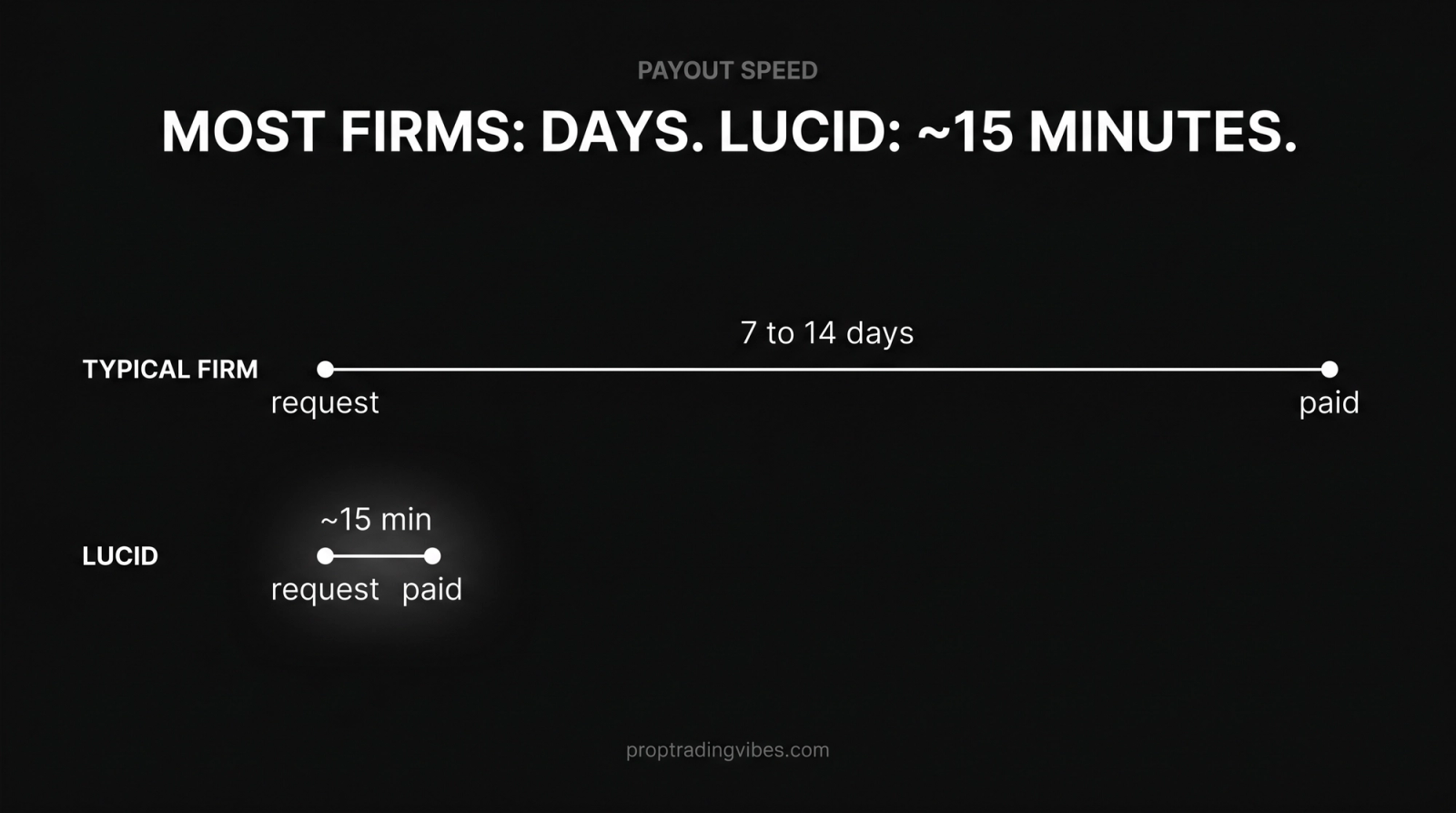
- Average payout processing of 15 minutes, fastest in the futures prop firm space
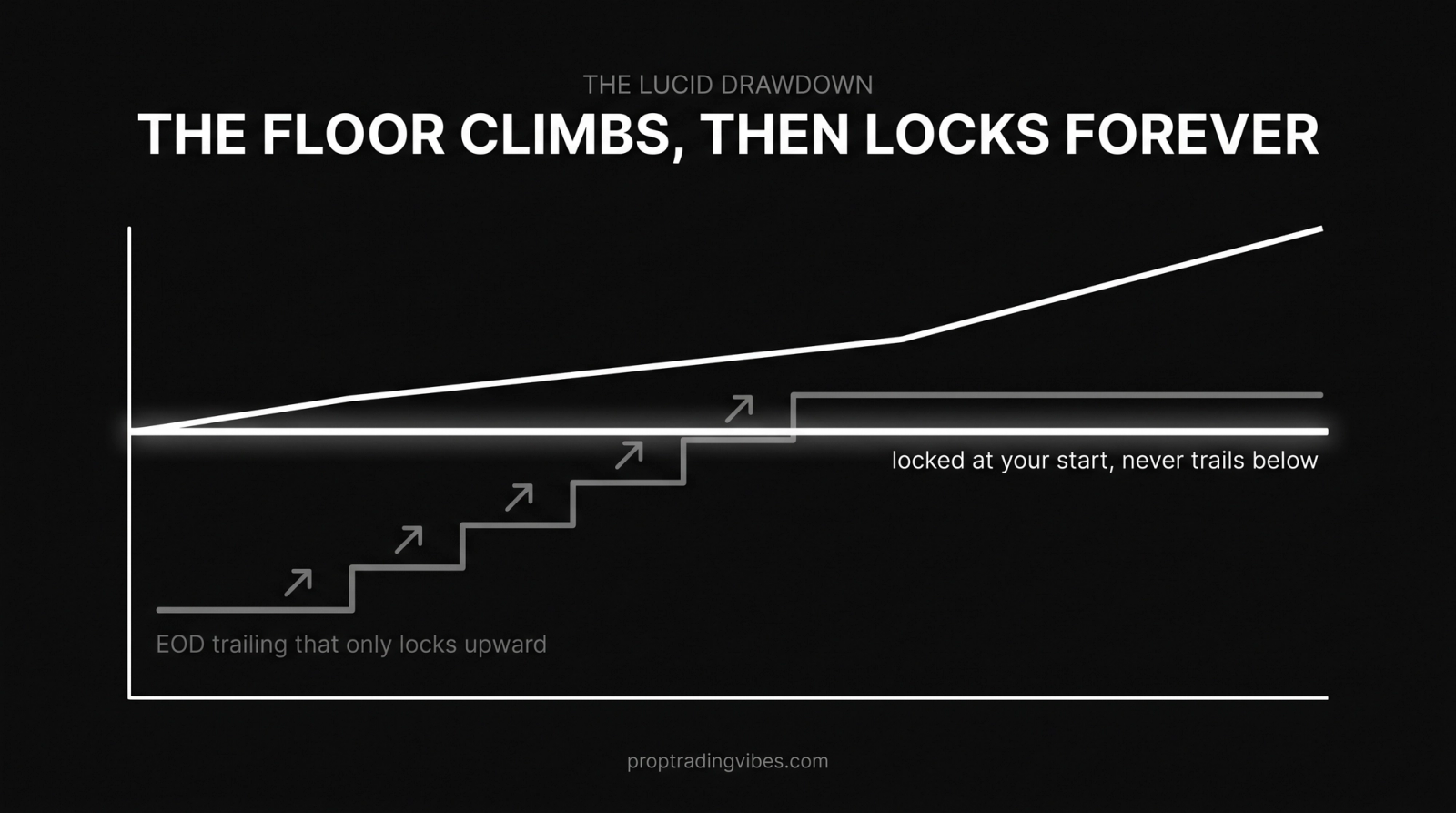
- EOD trailing drawdown that locks permanently at starting balance once reached
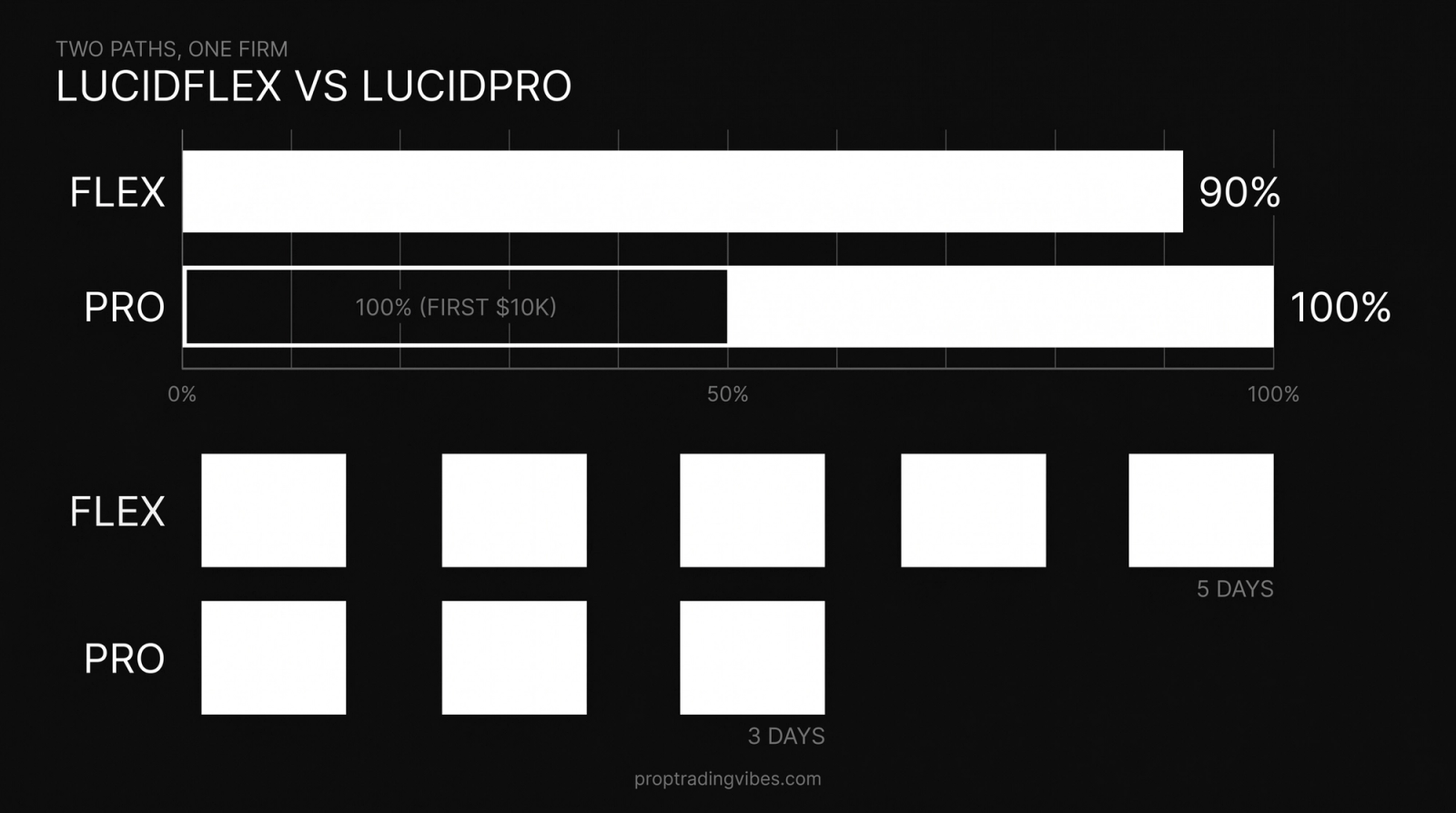
- 90/10 split with first $10K paid 100% to the trader on LucidPro and LucidDirect
- 9 supported platforms including Tradovate, TradingView, NinjaTrader, Sierra Chart, Bookmap, and Quantower
- Active founder presence in Discord with verified payout proof from community
- 4.8/5 Trustpilot rating, the highest in the competitive set
Cons
- Newer firm founded in 2025, no long track record compared to Topstep (since 2012) or TakeProfitTrader (since 2021)
- Sim-funded accounts (Flex, Pro) require all positions flat before market close, no overnight holds allowed
- February 2026 program overhaul retired LucidBlack and changed names, so older guides on the web may be outdated
- LucidPro and LucidDirect carry daily loss limits and consistency rules unlike Flex
- LucidMaxx is invite-only with no public pricing or application path
Lucid Trading Quick Reference
| Firm type | US-based futures prop firm |
|---|---|
| Founded | 2025 by AJ Campanella |
| Account types | LucidFlex, LucidPro, LucidDirect, LucidMaxx |
| Account sizes | 25K, 50K, 100K, 150K |
| Fee model | One-time evaluation fee, no monthly subscription |
| Profit split | 90/10 (LucidFlex), 100% first $10K then 90/10 (Pro, Direct) |
| Drawdown | EOD trailing, locks at starting balance |
| Daily loss limit | None on Flex, applied on Pro and Direct |
| Consistency rule | None on funded Flex |
| Payout speed | Under 15 minutes average |
| Platforms | Tradovate, TradingView, NinjaTrader, Sierra Chart, Bookmap, Quantower, plus more (9 total) |
| Trustpilot | 4.8 out of 5 |
Lucid Trading Account Types and Pricing
4 account types available.
| Plan | Price (VIBES) | Cycle | DLL | Split | Paul-tested |
|---|---|---|---|---|---|
| LucidFlex | $70$140 | 5-day | None | 90/10 | ✓ Yes |
| LucidPro | $92.5$185 | 3-day | $1,000 | 100% first $10K, then 90/10 | ✓ Yes |
| LucidDirect | $260$520 | — | $1,000 | 90/10 | No |
| LucidMaxx | — | 1-day | None | undisclosed | No |
Account Types & Pricing
The Four Current Programs (Flex, Pro, Direct, Maxx)
Lucid offers four distinct funding paths. LucidBlack is discontinued as of February 2026 (merged into LucidPro). Here's how each one works.
LucidFlex is the forgiving option. No daily loss limit. No funded consistency rule. 5 profitable days per payout cycle. 90/10 profit split. EOD trailing drawdown. Most traders should start here. The rules give you room to breathe, and the one-time fee means you're not bleeding money while you learn the structure.
LucidPro is the aggressive option. 1-day pass evaluation (yes, you can get funded in a single trading day). 3-day payout cycles. DLL active. Per-cycle consistency rule. 90/10 from day one (accounts before Nov 28, 2025 received 100% on first $10K, grandfathered only). 5 payouts to reach LucidLive. This is for traders who already know their edge and want the fastest possible withdrawal cadence.
LucidDirect skips the sim-funded phase entirely. You pass the evaluation and go straight to a live-funded account. 20% consistency rule. 90/10 from day one (pre-Nov 28, 2025 accounts: 100% first $10K, now grandfathered). DLL with soft breach levels. The February update removed the old 8-day minimum trading requirement and added a new 100K account size.
LucidMaxx is the newest tier, launched February 2026. Daily payouts. No caps. No DLL. EOD drawdown. Up to 5 accounts. Instant live capital with no sim phase. The catch: it's invite-only for proven PayoutMaxx traders. No public pricing, no application form. You get in when Lucid decides you've earned it.
Full Pricing Table (All Sizes, All Types)
Fee structure: Every account type uses one-time fees. No monthly subscriptions. Pay once, trade until you pass or breach. Topstep charges $49-$109/month. TakeProfitTrader charges $170/month for a 50K. Tradeify charges $139/month. If you need 3 months to pass an evaluation at Topstep, you've paid $147-$327. At Lucid you paid $185 once (or $92.50 with VIBES).
Activation fees: $0 across all account types. TakeProfitTrader charges $130 activation. Topstep charges $0-$149 depending on the plan.
Why I Trade the 50K LucidFlex (and Sometimes Pro)
The 50K is the sweet spot. The drawdown at $2,000 gives enough room to trade NQ and ES with reasonable position sizes without constantly worrying about a single bad candle killing your account. Smaller accounts (25K with $1,500 drawdown) are too tight for NQ in my experience. Larger accounts (100K, 150K) are more expensive and the drawdown doesn't scale proportionally enough to justify the extra cost for most traders.
I keep LucidFlex as my primary because no DLL and no funded consistency rule mean I can trade my way. Bad day? Walk away. Three losses in a row? Still fine, no daily limit to breach. I only switch to Pro when I want to stack fast payouts using the 3-day cycle and the first $10K bonus.
Who Lucid Trading Is For (And Who It Isn't)
Match yourself to Lucid Trading's structure before signing up. Based on the 4 account types, drawdown mechanic, and Paul's testing data.
- ·Traders who want their starting capital protected after the lock event
- ·Swing or position styles holding through close
- ·Aggressive sizers — at least one plan has no consistency rule on funded
- ·Traders allergic to daily loss limits — at least one plan has no DLL
- ·Cash-velocity seekers — fast payout cycles available
- ·First-time funded traders — 100% split tier on entry payouts
- ·Micro-account testers — smallest plan starts at $50K
Plan Economics: What Each Lucid Trading Account Actually Costs You
The headline price isn't the full picture. Here's the per-account math — buying-power cost, risk buffer, and breakeven estimate based on standard 30%-buffer-utilization assumptions.
| Plan | Buy-in | Risk buffer | Cost per $1K BP | Breakeven* |
|---|---|---|---|---|
| LucidFlex | $70VIBES | $2,000 | $1.40 | ~1 cycles |
| LucidPro | $92.5VIBES | $2,000 | $1.85 | ~1 cycles |
| LucidDirect | $260VIBES | $2,000 | $5.20 | ~1 cycles |
| LucidMaxx | — | $2,000 | — | — |
How to read this:
- Buy-in = price you pay to start the evaluation (with PTV code applied where available).
- Risk buffer = dollars between your starting balance and the Maximum Loss Limit — the absolute drawdown room before breach.
- Cost per $1K buying power = price ÷ starting balance × $1,000. Lower = cheaper leverage. Useful to compare account sizes within the firm and across firms.
- Breakeven estimate* = approximate number of payout cycles to recoup your buy-in, assuming you utilize 30% of your risk buffer profitably per cycle at the plan's profit split. This is a baseline expectation, not a guarantee — your actual cycle output depends on strategy and discipline.
*Breakeven uses a standard 30%-buffer-utilization-per-cycle assumption. Aggressive sizing can shorten breakeven (and increase breach risk); conservative sizing extends it.
Sweet spot for new users: LucidFlex at $70 is the cheapest entry to learn Lucid Trading's rules without risking a larger buy-in. If you're already confident in your strategy, sizing up to LucidFlex typically improves your cost-per-$1K-buying-power ratio.
My Experience with Lucid Trading
Lucid Trading launched in 2025 and grew faster than any futures prop firm I've seen. I've traded with them across LucidFlex, LucidPro, LucidBlack (now discontinued), and LucidDirect. 30 payout cycles completed across my accounts.
February 2026 changed the firm. LucidBlack got merged into an upgraded LucidPro. LucidLive got rebuilt from scratch with the escrow system ripped out entirely. A new invite-only LucidMaxx tier appeared for proven traders. If you read an older version of this review, forget most of it. The firm today is different.
Passing Evaluations and Getting Funded
I started with Lucid on a 50K LucidFlex account. One evaluation step, EOD trailing drawdown, no daily loss limit. Passed it on day 4 trading NQ during the US morning session. The process from payment to funded account took less than a week.
Since then I've passed 17+ evaluations across different account types. Not all of them survived. I breached a few LucidPro accounts early on by getting sloppy with the daily loss limit during FOMC releases. That's the thing about Lucid's different tiers: Flex forgives mistakes that Pro punishes.
The evaluation process itself is straightforward. Pick your account size, hit the profit target, respect the drawdown, and you're funded. No minimum trading days on LucidPro (1-day pass). LucidFlex and LucidDirect need profitable trading days, but there's no calendar-based minimum wait anymore on Direct after the February update removed the 8-day requirement.
The February 2026 Overhaul
February was massive for Lucid. Three big changes happened at once.
LucidBlack got discontinued. If you had a Black account, you could still reset through March 6, 2026, but after that it's gone. The good news: everything good about Black (3-day payout cycles, fast evaluations) got folded into the upgraded LucidPro.
LucidPro got a real upgrade. New pricing dropped across the board ($185 for 50K, down from before). The annoying 5 profitable days requirement got removed. You only need 5 payouts to reach LucidLive now instead of 6. DLLs were added, and the 100% first $10K bonus carried over from Black. If you traded Black and liked it, Pro is now the same thing but cheaper.
LucidLive got rebuilt from zero. The old system had a $30K starting balance, escrow vesting over 60 days, a "Make 5, Take 5" structure, and a Safety Net. All of that is gone. Today LucidLive starts at $0 balance with a one-time bonus ($1K-$4.5K depending on account size), daily payouts, EOD drawdown, and a 90/10 profit split (updated from 80/20 in March 2026). The escrow was the biggest complaint traders had about Lucid. Now it doesn't exist.
Where I Am Now
I'm running two active LucidFlex 50K accounts and one LucidPro 50K. The Flex accounts are my steady earners. I trade them conservatively, pull $1,500-$2,500 per cycle, and they just keep producing. The Pro account is more aggressive, taking advantage of the 3-day cycles and the 100% first $10K structure.
I made the jump to LucidLive after the March 2026 update moved the split to 90/10, matching sim-funded. On sim-funded accounts I keep 90% (Flex) or 100% of my first $10K (Pro). LucidLive's real capital is appealing, but the economics don't make sense until I'm consistently pulling larger numbers.
Total across all firms, I have a documented payout record spanning 15+ firms since 2021. Lucid accounts for 30 of those cycles, and the count is climbing. My rating for Lucid is 4.9/5, upgraded from 4.87 because the February Live changes addressed the single biggest complaint I had about the firm.
How Lucid Trading Drawdown Works
EOD · Locks up-onlyLucid Trading runs the most-forgiving mechanic in the prop industry. Your Maximum Loss Limit (MLL) starts at $2,000 below your starting balance and trails UP only at end-of-day close. Once it reaches your starting balance, it locks there permanently.
How Lucid Trading's mechanic works in practice
- Intraday equity drops do NOT move the MLL — only end-of-day close matters.
- After every profitable EOD close, the MLL ratchets up by the profit increment.
- Once MLL = starting balance: lock engaged. From this point, only a daily-loss-limit breach or a full wipe to starting balance can break the account.
- After lock, you can ride a drawdown back to starting balance without breaching — your starting capital is permanently protected.
Best fit
Best for swing traders, position holders, and anyone who values starting-capital protection. The mechanic forgives intraday volatility and rewards traders who close cleanly each day.
What to watch out for
- Pre-lock state is more fragile than headline numbers suggest — the trail can catch you mid-cycle if you size aggressively.
- A single bad close before lock can move the MLL above starting balance, making the next intraday dip lethal.
- Reaching the lock requires consistent EOD profitable days — choppy markets delay it.
How Lucid Trading Payouts Actually Work
Payout cycle ranges from 1 to 5 days depending on plan. 3 payout methods supported.
Cycle requirements per plan
- LucidFlex — minimum 5 days between payouts on funded.
- LucidPro — minimum 3 days between payouts on funded.
- LucidMaxx — minimum 1 day between payouts on funded.
Payout method comparison
| Method | Fees | Speed | When to use |
|---|---|---|---|
| Wire / Bank Transfer | $10-30 typical | 1-3 business days | Universal but expensive. Use only when others unavailable. |
| PayPal | PayPal fees apply | Same-day | Convenient but PayPal cuts ~2-3% — least efficient. |
| Crypto | Network gas only | Minutes | USDC/USDT typical. Fastest for international traders. |
Practical takeaway: Lucid Trading's cycle length means you can realistically expect ~30 payouts per month on a profitable funded account. The actual processing time after request varies by method — pick the option that matches your residency and crypto-comfort.
Lucid Trading Trading Rules
What Gets Your Account Killed
Exceeding the Maximum Loss Limit (MLL). Your account equity drops below the MLL and it's over. Instant breach. On a 50K account, the MLL starts $2,000 below your starting balance. This is an EOD trailing drawdown, so it only updates at market close, not intraday. Huge difference from firms like TakeProfitTrader that use intraday trailing.
Hitting the Daily Loss Limit (DLL) on Pro and Direct. LucidFlex has no DLL. That's a feature. LucidPro and LucidDirect have daily loss limits that act as a soft breach on Direct (account pauses, doesn't terminate) and a hard limit on Pro. On a 25K LucidDirect, the DLL soft breach levels are $600, $1,200, $1,800, and $2,700.
Trading restricted instruments. Stick to the approved futures contracts. Lucid publishes the list on their help center.
Holding through market close on sim-funded accounts. All positions must be flat before the session closes. No overnight holds. No weekend holds. Only LucidLive allows open positions across sessions.
The Rules That Actually Help You
EOD trailing drawdown is the single best rule at Lucid for traders who experience intraday volatility. Here's why: if you're up $1,500 during the session but close the day up $300, your MLL only trails based on the $300 close, not the $1,500 high. At firms with intraday trailing (TakeProfitTrader), that $1,500 peak would have moved your drawdown permanently. EOD trailing protects you from the psychological mistake of watching profits evaporate and having your drawdown lock in at the worst moment.
No funded consistency rule on LucidFlex. Most firms cap how much of your total profit can come from a single day. Topstep enforces 40% consistency. Tradeify enforces 35%. LucidFlex: 0%. If you make $3,000 on Monday and $50 on Tuesday, that's a valid payout.
One-time fees with free resets during promos. When you breach an evaluation, you don't restart a monthly subscription. You buy a new one, often at a discount during Lucid's frequent promos. Some periods include free resets.
EOD Trailing Drawdown: How It Really Works (with math)
Let me walk through a real scenario on a 50K LucidFlex.
Day 0: Starting balance $50,000. MLL = $48,000 ($2,000 below).
Day 1: You trade NQ and close the day at $50,800. MLL trails up to $48,800.
Day 2: Bad day. You close at $50,200 (down $600 from yesterday's close). MLL stays at $48,800. It only trails UP, never down.
Day 3: Great session. You hit $52,000 intraday but close at $51,400. MLL trails to $49,400 (based on the $51,400 close, NOT the $52,000 high).
Day 4: You close at $51,500. MLL trails to $49,500.
Lock point: Once MLL reaches $50,000 (your starting balance), it locks. From here, you trade with house money. Your account can never be breached by the trailing drawdown again (unless you lose below $50,000).
The key insight: the MLL locks at your starting balance, not at some arbitrary level. Once locked, you have permanent downside protection. This takes about $2,000 in accumulated end-of-day profits to reach.
Compare this to intraday trailing at TakeProfitTrader. Same scenario on Day 3: your MLL would trail to $50,000 based on the $52,000 intraday high, not the $51,400 close. That $600 difference in drawdown protection matters on volatile instruments like NQ.
Strategies and Best Practice
On a 50K LucidFlex, I have $2,000 of drawdown to work with. My approach:
Max risk per trade: $400 (20% of total drawdown). On NQ, that's roughly 2 points of adverse movement per contract, or 4 points with a micro. On ES, it's 8 points per contract. I rarely take full-size risk on a single trade.
Daily loss limit I set for myself: $600. Lucid doesn't enforce a DLL on Flex, but I enforce my own. Three losing trades at $200 each and I'm done for the day. This keeps me from revenge-trading into a hole that would take a week to recover.
Payout target per cycle: a comfortable number, not the maximum. I don't try to maximize the cap. I hit a comfortable number, request the payout, and start the next cycle fresh. Grinding for the maximum cap leads to overtrading in my experience.
The approach is different on LucidPro. The DLL is enforced by the firm, so I size down. I trade 1 NQ contract maximum and aim for 10-15 points per session. The 3-day payout cycle means I don't need huge daily wins. Consistent days compound fast when you're withdrawing every 3 days.
Handling the Payout Cycle
LucidFlex cycles work like this: you hit the payout minimum, request a withdrawal, Lucid processes it (usually 15 minutes), and your balance resets to start a new cycle. You need 5 profitable days within the cycle to be eligible for a withdrawal.
LucidPro cycles are 3 days. Trade for 3 days, meet the per-cycle consistency requirement, request a payout. The consistency rule on Pro means no single day can make up too large a percentage of your cycle profit. I handle this by spreading my trading across all 3 days rather than trying to hit a home run on day 1.
After 5 payouts on Pro (or 6 on Flex), you become eligible for LucidLive. That's the transition from sim-funded to real capital. LucidLive was updated to 90/10 in March 2026, matching sim-funded. The transition decision is now about account size, not split rate. But the daily payouts on Live are attractive for traders who want immediate access to profits.
Common Mistakes I See Traders Make
Oversizing on day 1. The evaluation has the same drawdown as the funded account. If you blow 50% of your drawdown in the first session, you've put yourself in a terrible position. Start with half your planned size and scale up after you've got a profit cushion.
Ignoring the DLL on LucidPro. Traders who switch from Flex to Pro forget they now have a daily loss limit. One bad trade that would be survivable on Flex can trigger the DLL on Pro and either breach (Pro) or pause (Direct) the account.
Holding through news on funded accounts. FOMC, CPI, NFP. These events create 20-50 point NQ candles in seconds. EOD drawdown doesn't help you if a single candle wipes out your entire $2,000 buffer in real-time. The MLL only trails at end-of-day, but the breach happens intraday if your equity hits it.
Chasing the maximum payout cap on Flex. The caps on Flex range from $1,500 to $4,000 depending on account size and payout number. Some traders keep trading to fill the cap when they've already hit a solid number. That extra trading isn't worth risking a $35,000 account.
Lucid Trading Platforms
What I Use (Tradovate + TradingView)
I run Tradovate as my execution platform with TradingView as my charting frontend. The connection is seamless. TradingView's charting is the best in the industry, and routing orders through Tradovate means I get Lucid's standard execution and data feed.
Setup takes about 10 minutes. You create your Tradovate account, connect it to your Lucid evaluation or funded account through the dashboard, then link TradingView to Tradovate. Orders placed on TradingView execute through Tradovate.
Full Platform Support by Account Type
Lucid supports 9 platforms, which is more than most competitors. Topstep is locked to Tradovate and NinjaTrader. TakeProfitTrader supports NinjaTrader, Tradovate, and a few others. Lucid gives you the full Rithmic ecosystem plus Tradovate's native options.
LucidPro supports DLLs (Dynamic Link Libraries) as of the February 2026 update. If you use custom indicators or automated tools on NinjaTrader or Sierra Chart, that matters. LucidFlex has always supported them. Some firms restrict DLL usage entirely.
Mobile and Web Access
Tradovate has a solid web app and mobile app. I've placed trades from my phone during lunch when I spotted a setup on ES. It works. It's not ideal for scalping, but for managing existing positions or taking swing entries, it's functional.
TradingView's mobile app is excellent for chart monitoring, and you can execute trades through the Tradovate connection directly from TradingView mobile. NinjaTrader doesn't have a true mobile app, so if you're a NinjaTrader user, you're limited to desktop.
Trust and Legitimacy
I've completed 30 payout cycles with Lucid. Every payout processed in under 4 hours, with most completing in 15 minutes. Plaid ACH deposits for US traders, WorkMarket for international, PayPal, and crypto options.
The Lucid community on Discord is active with regular payout screenshots and proof. Lucid publishes payout milestones publicly. The firm has a 4.8/5 on Trustpilot, which places it above Topstep (4.3/5) and TakeProfitTrader (4.4/5).
I've had zero payout disputes with Lucid. Zero rejected withdrawals. Zero "under review" holds. That's across 30+ payouts over several months. Contrast that with some firms where traders report multi-week delays or unexplained rejections.
Company Background (AJ Campanella, US-based)
Lucid Trading was founded by AJ Campanella in 2025. US-based operation. AJ is active on social media and in Lucid's Discord, which is unusual for a prop firm founder. Most founders hide behind support desks.
The firm launched with LucidFlex and has been iterating rapidly. LucidPro, LucidBlack, LucidDirect, and LucidLive all launched within the first year. LucidMaxx arrived in February 2026. The pace of innovation is fast, possibly the fastest in the industry.
Lucid uses standard industry infrastructure: Tradovate and Rithmic for trade execution, established payment processors for payouts, and a custom dashboard for account management.
Red Flags and Concerns: Being Honest
Age. Lucid launched in 2025. Topstep has been operating since 2012. TakeProfitTrader since 2021. Tradeify since June 2024. Lucid is the youngest serious competitor in the space. Younger firms carry more risk. They haven't been tested by a prolonged bear market, regulatory changes, or years of scaling pressure.
Rapid changes. Four account type overhauls in less than a year. While I've framed these changes positively (because they genuinely improved the product), frequent structural changes can also signal that the firm hasn't figured out its model yet. Stable firms don't need to rebuild their programs every quarter.
Invite-only tier opacity. LucidMaxx has no public pricing, no qualification criteria, and no application process. That's unusual. It means Lucid controls who gets access based on undisclosed metrics. For a firm that otherwise operates transparently, this is a blindspot.
LucidLive's 90/10 split. Dropping from the 100 percent first-\$10K bonus (sim-funded) to the flat 90/10 split (live) when you've already proven yourself through 5-6 payout cycles feels like a step backward. Tradeify and MyFundedFutures maintain 90/10 on live capital.
I'm being direct: none of these are dealbreakers. They're areas where Lucid has room to improve. My 30 payout cycles tell a different story than a list of concerns. But you should have the full picture.
How Long Lucid Has Operated vs Competitors
Lucid's Trustpilot score is the highest despite being the youngest. That's worth something. But longevity and a good review score measure different things. Topstep has survived 13 years of market conditions, regulatory scrutiny, and competitive pressure. Lucid hasn't been tested by any of that yet.
My take: trade with Lucid, but don't put 100% of your prop firm capital into a single firm. I run accounts at Lucid, TakeProfitTrader, and Tradeify simultaneously. Diversification applies to prop firms too.
Who Is Behind Lucid Trading?
Lucid Trading is the venture of AJ Campanella, who launched the firm in 2025 and runs it as a US-based operation. He is active in the Lucid Discord, where he posts regularly and where community payout proof shows up alongside my own, and that visibility is a real point in the firm's favor. The honest caveat is age: this is a 2025 firm, so it does not carry the multi-year public track record of a Topstep or a TakeProfitTrader, and I weight that in the rating. What I can stand behind is my own record with Lucid, 30 payout cycles, all paid with zero denials.
How Lucid Trading Compares
Lucid Trading vs Topstep
Topstep has a 13-year track record and a 40 percent funded consistency rule. Lucid is newer but more flexible on rules and pays in 15 minutes instead of 1 to 3 business days.
Topstep is the legacy choice for traders who prioritize firm longevity and regulatory comfort. Lucid wins on payout speed, one-time fee structure, and zero consistency rule on LucidFlex. Topstep wins on history and breadth of educational content. If you want the longest paper trail, Topstep. If you want the most forgiving rule set and fastest cash, Lucid.
Lucid Trading vs Apex Trader Funding
Apex offers static drawdown and a larger account-size catalog. Lucid uses EOD trailing that locks at starting balance, which most active day traders find more forgiving.
Apex is the volume play with broader account sizes and a static drawdown that simplifies risk math. Lucid skews toward swing-style and scalping traders with its EOD trailing drawdown and lock-at-start mechanic. The choice is mostly mechanic preference: static MLL discipline (Apex) versus a drawdown that ratchets up and locks (Lucid).
Lucid Trading vs MyFundedFutures
Both offer instant-funded paths and EOD drawdown. Lucid edges ahead on payout speed and Discord engagement, MyFundedFutures has the more aggressive scaling plan.
MyFundedFutures and Lucid are the two firms most often compared head to head in 2026. MyFundedFutures has the longer scaling roadmap once you are funded. Lucid has the faster payout speed (under 15 minutes versus same day) and the more active founder presence. For first-time funded traders, Lucid is the simpler on-ramp. For traders chasing a fast scale-up, MyFundedFutures.
Lucid Trading Deep Comparison
Where Lucid Wins
One-time fees. No other firm in this comparison offers one-time evaluation fees across the board. Tradeify, TakeProfitTrader, and Topstep all charge monthly subscriptions. If you need more than one month to pass (most traders do), Lucid's cost advantage grows every month.
Payout speed. 15 minutes average. Tradeify takes about an hour. TakeProfitTrader processes same-day. Topstep takes 1-3 business days. If cash flow matters to you (and it should), Lucid is the fastest.
No funded consistency on Flex. Only TakeProfitTrader matches this at 0% consistency on funded accounts. Topstep enforces 40%, Tradeify enforces 35%. If your trading style produces uneven daily P&L (which most scalping strategies do), Flex removes a major obstacle.
EOD trailing drawdown. Most firms have moved to EOD trailing, but TakeProfitTrader still uses intraday trailing. That difference alone makes Lucid's drawdown mechanics more forgiving for active day traders.
Platform variety. Nine supported platforms versus Topstep's two (Tradovate, NinjaTrader). If you use Sierra Chart, Bookmap, Quantower, or MotiveWave, Lucid supports it. Most competitors don't.
Where Lucid Loses
Company history. Topstep has 13 years of track record. TakeProfitTrader has 4+. Lucid has about 1 year. That's not nothing, and it's the primary risk factor I'd flag for cautious traders.
LucidLive profit split. Lucid updated LucidLive from 80/20 to 90/10 in March 2026, matching the industry standard. Tradeify and Topstep also offer 90/10. This was previously a disadvantage; now that the split matches the industry standard, the daily payout frequency more than offsets accepting 10 percent less per dollar earned.
Subscription firms can be cheaper short-term. Topstep's 50K starts at $49/month. If you pass in month 1, you spent $49 versus Lucid's $185 (Pro) or $140 (Flex). The one-time fee model only wins if you take more than a month. Most traders take more than a month. But fast passers pay more upfront at Lucid.
Payout caps on Flex. Tradeify offers 100% of your first $15K with no per-cycle cap. Lucid Flex caps payouts at $1,500-$4,000 per cycle depending on the payout number. If you're consistently profitable and want to withdraw large amounts quickly, Tradeify and LucidPro are better options than LucidFlex.
My Recommendation by Trader Type
The cautious beginner: Start with LucidFlex 50K ($140). No DLL, no funded consistency, EOD trailing. The most forgiving rule set in futures prop trading. You'll make mistakes. Flex won't punish most of them.
The aggressive scalper: LucidPro 50K ($185). 1-day pass evaluation. 3-day payout cycles. 100% of your first $10K. If you already have a profitable strategy and want the fastest path to withdrawals, Pro is built for you. Just respect the DLL.
The experienced trader who wants real capital: LucidDirect. Skip the sim-funded phase entirely. 20% consistency rule and DLL soft breaches, but you're trading with real money from day one. The 100K account size added in February makes this viable for larger position sizing.
The budget-conscious evaluator: If you're working through multiple evaluations and want to minimize costs, Topstep at $49/month is cheaper if you pass within 3 months. But if you expect to need time, Lucid's one-time fee protects you from accumulating monthly charges.
The proven profitable trader: Wait for a LucidMaxx invitation. Daily payouts, no caps, no DLL, instant live capital. It's the best deal in prop trading, if you can get access to it. Until then, LucidPro with 3-day cycles is the closest alternative.
Restricted Countries for Lucid Trading
Lucid Trading restricts traders from the following countries. The list reflects the firm's published eligibility policy at last review.
- Iran
- North Korea
- Cuba
- Syria
- Crimea region
- Donetsk region
- Luhansk region
- Sudan
- Russia
- Belarus
- Myanmar
Full breakdown including special-case territories: read the Lucid Trading restricted countries guide.
Lucid Trading FAQ
What is Lucid Trading?
What makes Lucid Trading different from other prop firms?
What is the profit split at Lucid Trading?
How does the EOD trailing drawdown work at Lucid?
What happened to LucidBlack?
What is LucidMaxx?
How fast are payouts at Lucid Trading?
What platforms does Lucid Trading support?
Is Lucid Trading legit?
How does LucidLive work after the February 2026 update?
Can I hold positions overnight at Lucid Trading?
How much does a Lucid Trading evaluation cost?
What is the minimum account size at Lucid Trading?
Should I choose Lucid Trading in 2026?
The Bottom Line
After 8 plus months and 30 completed payout cycles, Lucid Trading is the futures prop firm I keep returning to. The combination of EOD trailing drawdown, 15-minute payouts, and zero consistency rule on LucidFlex makes it the simplest path to a funded futures account in 2026. Pair it with a legacy firm like Topstep if a longer track record matters to you.
Methodology 8+ months · 30 payout cycles · last tested May 2026
Every review on PTV comes from accounts I fund and trade with my own money. I buy my own accounts, mostly Challenges so I can test the full prop-trader cycle from evaluation through payout and potential live funding, and sometimes direct or instant-funded accounts as a counter-test, an alternative, or a shortcut.
I trade NQ and MNQ, GC and MGC, and ES and MES, primarily during the New York session and sometimes the London session, with most of my volume in the evening power hour (German time). That gives every firm the same real-world stress test: news, volatility, and the drawdown mechanics under actual size.
On Lucid I have run LucidFlex and LucidPro and completed 30 payout cycles with zero rejections, all under code VIBES.
Pricing and rules are verified against Lucid Trading's official help center the week of last test. Ratings reflect fit for active futures traders, not a one-size-fits-all score.
Read the full methodology, the gates, the mechanics, and the proof →
Update Log 3 changes