
Table of contents
Quick Answer, DXTrade: DXTrade is a web-based, white-label trading platform by Devexperts that powers the front-end for 40+ prop firms in 2026.
- Browser-only, no install: log in from any device and your account is ready.
- TradingView charting engine baked in, risk dashboard native (not a plugin).
- No Expert Advisors or custom algo scripts on most firm implementations.
- Quality varies by firm: the UI is identical everywhere; the infrastructure behind it is not.
- Best fit for discretionary traders who don't rely on automation.
What Is DXTrade and Who Built It?
Devexperts has been building trading software since 2002. Their most notable prior project: thinkorswim, the platform TD Ameritrade ran before the Schwab acquisition. DXTrade launched in May 2020 as a SaaS platform licensed directly to prop firms and brokers.
Three flavors exist:
| Version | Asset coverage |
|---|---|
| DXTrade CFD | Forex, CFDs, spread bets, crypto |
| DXTrade XT | Stocks, CME futures, options, bonds |
| Prop Trading Stack | Evaluation + challenge management layer |
Most prop firms license the CFD version or the full prop stack. A growing number have added DXTrade XT for futures access, connecting it to dxFeed for real-time CME data.
The prop industry standardized on DXTrade for a specific reason. MetaQuotes tightened licensing terms, making MT4/MT5 expensive and complicated for firms running proprietary evaluations. cTrader requires specific broker partnerships. DXTrade offered a purpose-built solution with native challenge tracking, automatic drawdown enforcement, and position liquidation: no third-party plugins needed.
The White-Label Reality
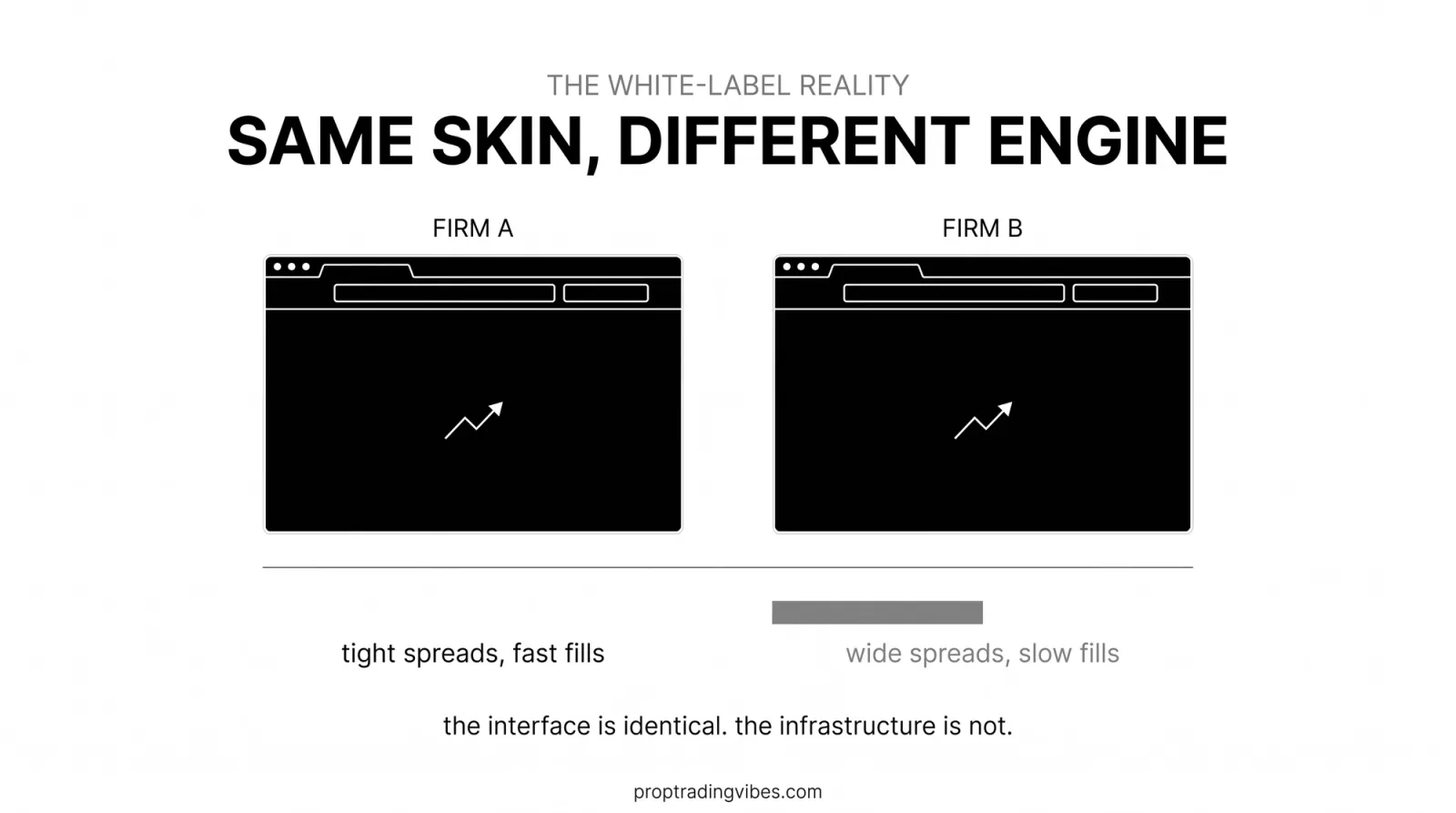
Every firm that runs DXTrade has its own branded instance. Same core code, different logo and color scheme. Your FTMO DXTrade login and a Brightfunded DXTrade login look similar but run on separate infrastructure. That's the key thing to understand: the platform is standardized, the experience behind it is not.
The Trading Experience Day to Day
Honest assessment: DXTrade is competent. Not exceptional, not problematic. Competent.
Web-based means zero installation friction. Open Chrome, log in, trade. Works on Windows, Mac, Linux. The mobile apps (iOS and Android) mirror the web experience for monitoring and basic order management.
Charting
DXTrade uses TradingView's charting engine. You get 100+ indicators, Heikin Ashi, Renko, standard candlestick views, multi-timeframe layouts, saved templates. For most traders this is familiar territory. One caveat: sub-minute timeframes can lag during high-volatility sessions. Scalpers on 15- or 30-second charts have reported sluggish updates. On 5-minute charts and above, performance is solid.
If you're already a Quantower or DeepCharts user running futures through a dedicated platform, DXTrade's charting will feel lightweight. For forex and CFD discretionary work, it's fine.
Order Types and Execution
Market, limit, stop, and OCO orders are all available. You can drag take-profit and stop-loss levels directly on the chart. One-click trading mode is configurable.
Execution speed depends on the firm's liquidity provider, not DXTrade. The platform routes your order; what happens next is the firm's infrastructure problem. Tight spreads and fast fills at one firm, inconsistent fills at another, the DXTrade interface looks identical in both cases.
Risk Dashboard
This is DXTrade's clearest competitive advantage over MT5. The risk overlay shows:
- Current P&L
- Daily drawdown status vs. limit
- Max trailing drawdown threshold
- Open position exposure
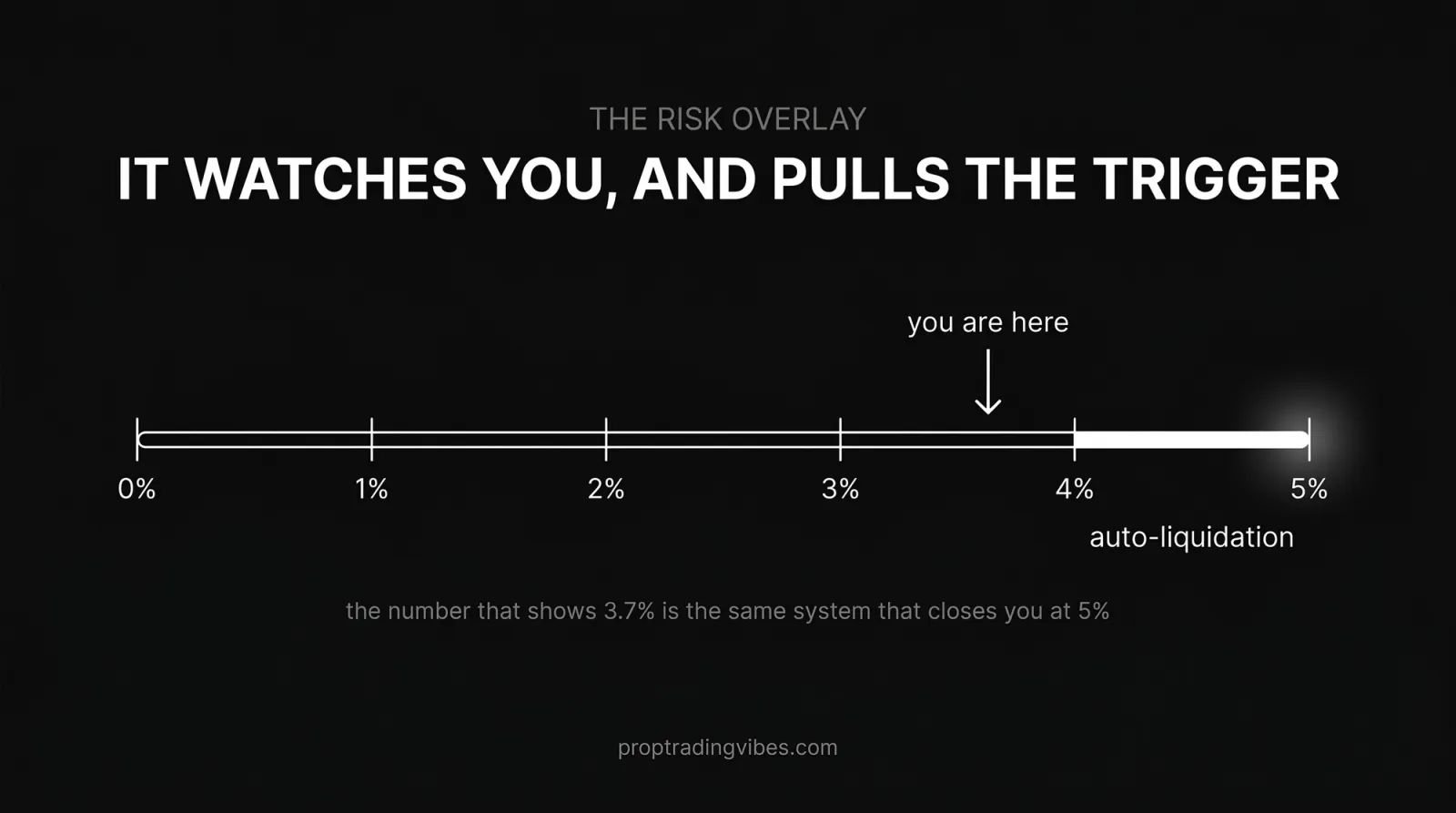
All in real time, built into the platform itself. If you're approaching your daily loss limit, you see it. If the firm has configured automatic liquidation, the platform closes your positions before you breach. No manual calculation, no separate spreadsheet, no plugin that might lag.
Firms can configure EOD Trailing, Intraday Trailing, or Static drawdown enforcement. DXTrade enforces whichever the firm sets. If your firm uses EOD Trailing drawdown, the lock level ratchets up at end of day as your balance grows, and DXTrade tracks it in real time.
Strengths: What DXTrade Gets Right
Zero installation. Trade from any device, anywhere. On a travel laptop, in a hotel, on a borrowed computer. The account is in the browser. Nothing to configure.
Native prop firm integration. Challenge progress tracking, drawdown monitoring, automatic liquidation, and evaluation analytics are built into the platform rather than bolted on via plugins that can fail or delay. The number that shows your drawdown at 3.7% is the same system that will liquidate you at 5%. That coherence matters.
Performance analytics. Trade journal, win/loss ratio, risk-reward breakdown, average holding time, note-tagging per trade. Built in. You'd normally pay for a separate journaling subscription to get this.
Broad asset architecture. The platform itself supports forex, CFDs, crypto, stocks, futures, bonds, and options. What you can actually trade depends on your firm's configuration, but DXTrade XT with dxFeed has legitimate futures coverage including Level 2 order book data.
Weaknesses: The Honest Assessment
No Expert Advisors. This is the dealbreaker for algorithmic traders. DXTrade doesn't run MQL4/MQL5 EAs or cTrader's cAlgo bots. No automated execution. No custom scripts. If your strategy is system-based, DXTrade eliminates itself.
Devexperts has been building out API access, but as of June 2026 the automation support is meaningfully behind both MT5 and cTrader. This eliminates a significant segment of traders.
Indicator library depth. MT5 has two decades of community development and 10,000+ custom indicators in the MQL5 marketplace. DXTrade relies on TradingView's built-in library. Solid, but if you've built or bought custom MT5 indicators, they don't transfer.
Variable infrastructure quality. Every firm runs its own DXTrade instance, so the back-end quality varies. A well-capitalized firm with institutional liquidity behind DXTrade delivers tight spreads and fast fills. A smaller firm on budget infrastructure can show the same clean interface with significantly worse execution. The UI hides this.
Mobile scalping is rough. The mobile app handles monitoring and simple order management. Active fast-timeframe scalping on mobile is clunky: too many taps to modify orders, chart resizing isn't smooth, order book depth is limited.
Which Prop Firms Use DXTrade?
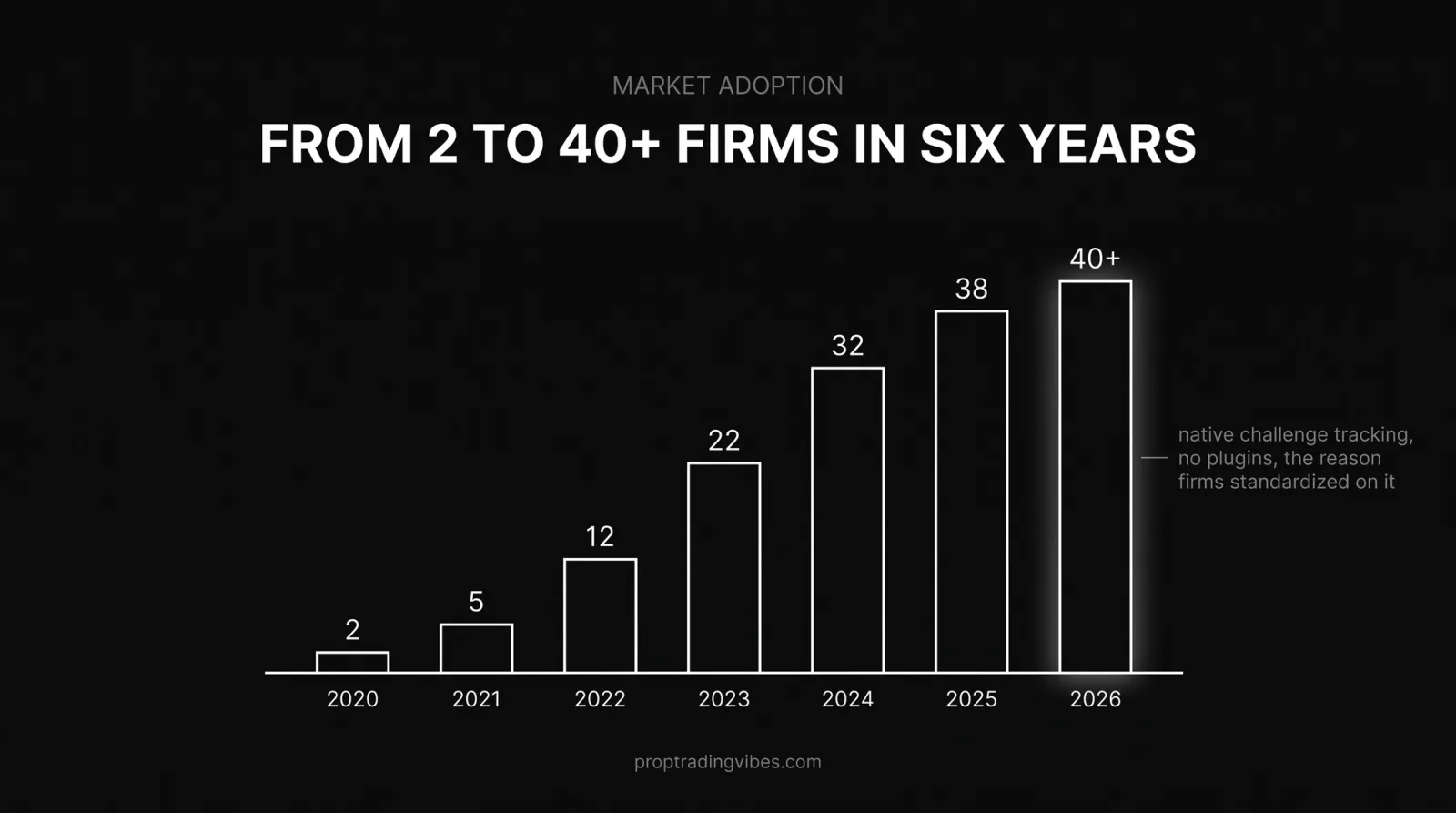
DXTrade is now the most common platform in the prop space by firm count. Among verified firms:
| Firm | DXTrade Use | Notes |
|---|---|---|
| Tradeify (Crypto) | Primary platform | Crypto-specific DXTrade implementation |
| Breakout | Platform option | Alongside other platform choices |
| Brightfunded | Platform choice | cTrader also available |
| Apex Trader Funding | Not DXTrade | Uses Rithmic/Tradovate for futures |
| MyFundedFutures | Not DXTrade | Rithmic-based futures platform |
| TradeDay | Not DXTrade | Tradovate/NinjaTrader |
For futures-focused firms like Apex Trader Funding or MyFundedFutures, DXTrade isn't typically in the stack. Those firms run purpose-built futures platforms with Rithmic data feeds. DXTrade's futures presence is growing via the DXTrade XT variant but it's still newer infrastructure compared to dedicated futures platforms.
US trader note: MT5 and cTrader face regulatory friction in the United States. DXTrade has no such restrictions, making it the default or only option at several firms for US-based traders. If you're trading from a US IP and a firm you're evaluating has MT5/cTrader available, check whether those apply to you before signing up.
DXTrade vs. MT5 vs. cTrader
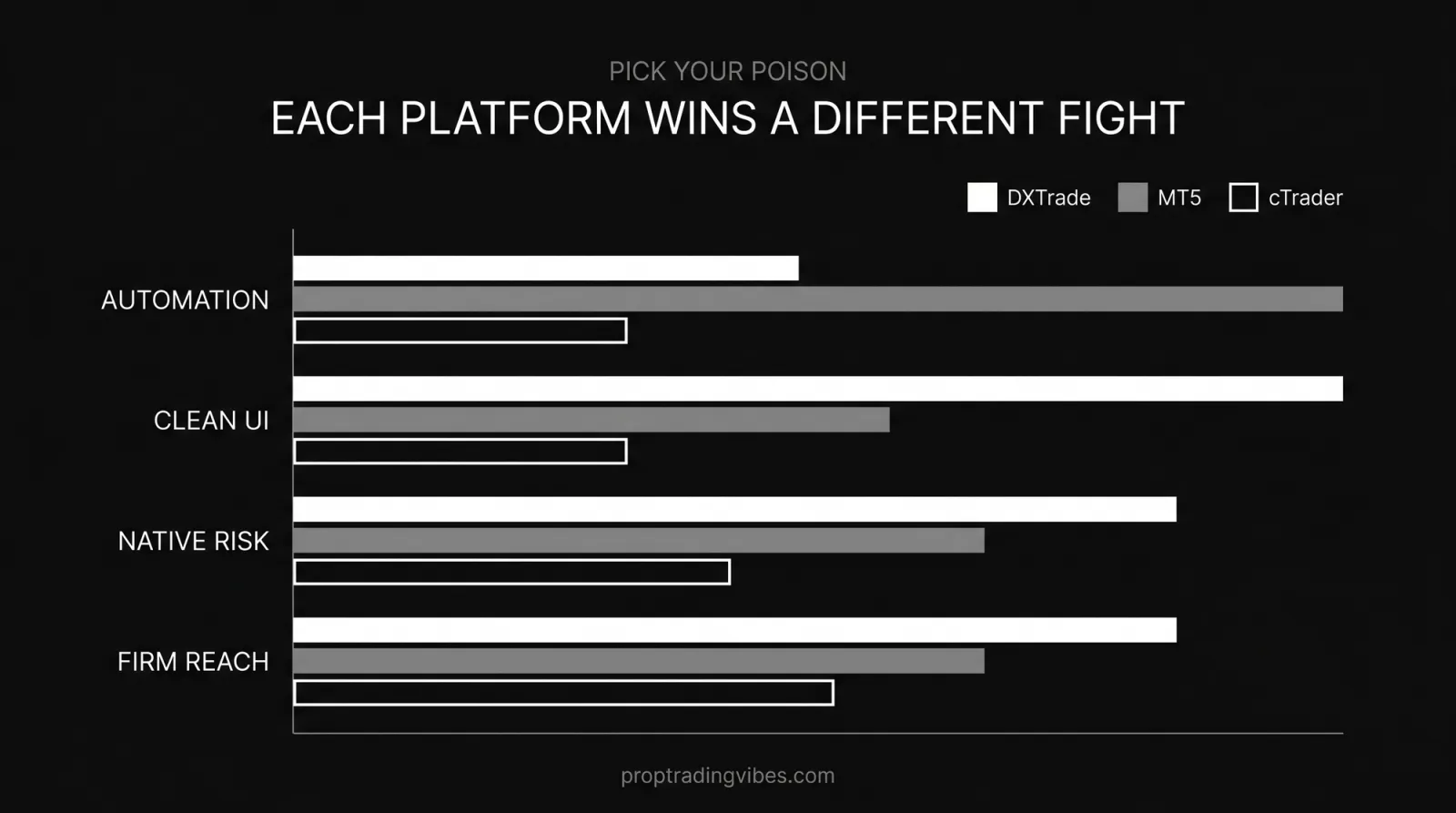
Three platforms, three different positions in the market:
| Criterion | DXTrade | MT5 | cTrader |
|---|---|---|---|
| Installation | None (browser) | Required | Required |
| EA/Algo support | Minimal | Full MQL5 | Full cAlgo |
| Custom indicators | TradingView library | 10,000+ MQL5 | C# ecosystem |
| Risk dashboard | Native, tight | Plugin-based | Plugin-based |
| Prop firm availability | 40+ firms | Very common | Moderate |
| UI modernity | Clean, modern | Dated | Modern |
| US availability | Unrestricted | Restricted | Limited |
| Futures (CME) | Via DXTrade XT | Limited | Limited |
MT5 wins on raw feature depth. Two decades of community development, the MQL5 marketplace, and deep customization make it the default for algo traders. The trade-off is a dated interface and prop firm integration that relies on third-party plugins.
cTrader is the premium option for algorithmic traders. Native C# development through cAlgo, Level II market depth, transparent execution. For system traders, it's objectively the strongest of the three. The constraint: fewer firms offer it, and it requires specific broker partnerships.
DXTrade lands between them. Better UI than MT5. Worse automation than both. Better native prop integration than either. Accessible from any browser without installation.
For discretionary traders who draw levels, wait for setups, and execute manually, DXTrade is adequate. Possibly preferable to MT5 for the cleaner interface and risk dashboard alone. For anyone running systems, it's the wrong tool.
Should You Trade on DXTrade?
If your firm offers multiple platforms: choose based on your strategy. Need EAs? MT5. Need cAlgo? cTrader. Trade discretionarily and want a clean browser interface with a solid risk overlay? DXTrade is fine.
If DXTrade is your only option (common for US traders at several firms): understand what you're getting. Competent platform, good charting, excellent risk management integration, zero automation. For most discretionary prop traders, that's the entire checklist.
One thing to verify before buying any evaluation: ask about the firm's liquidity provider and execution setup. The DXTrade interface tells you nothing about the infrastructure running behind it. A clean UI can mask poor fills and wide spreads.
DXTrade is actively developing. As of June 2026, Devexperts has shipped AI-powered analytics integration, expanded the Arizet risk partnership, and is growing DXTrade XT's futures coverage. The platform two years from now will likely be meaningfully stronger. But the EA gap and shallow custom indicator library are structural, not cosmetic, and they haven't closed yet.
Frequently Asked Questions
What is DXTrade?
DXTrade is a white-label trading platform built by Devexperts, a financial software company that also created thinkorswim. It's web-based (no installation), supports forex, CFDs, crypto, and futures through DXTrade XT, and is licensed by 40+ prop firms as of 2026. The platform includes TradingView charting and native risk management built specifically for prop firm evaluation structures.
Who built DXTrade?
Devexperts, founded in 2002 and headquartered in Germany, built and maintains DXTrade. Their previous major project was thinkorswim for TD Ameritrade, an institutional-grade platform acquired as part of a deal valued at over $600M. DXTrade launched in May 2020 as a SaaS platform targeting prop firms and brokers.
Can I run Expert Advisors on DXTrade?
No, not on most prop firm implementations. DXTrade doesn't support MQL4/MQL5 EAs or cTrader's cAlgo bots. If your strategy requires automated execution, you need a firm offering MT5 or cTrader. Devexperts is building API access, but full EA-equivalent automation isn't available as of June 2026.
Which prop firms use DXTrade?
Tradeify 247 currently supports DXtrade and MT5, with MT5 unavailable to US traders. TradingView is coming soon, not active. TradeDay is not a four-platform-only firm: it documents CQG and a separate broad Rithmic population.
Is DXTrade better than MetaTrader 5?
Depends entirely on what you need. DXTrade has a cleaner interface, zero install friction, and a superior native risk dashboard. MT5 has full EA support, a massive custom indicator library, and decades of community development. For discretionary traders, DXTrade is arguably more pleasant. For algorithmic traders or anyone relying on custom indicators, MT5 is the better tool.
Why do US traders often get DXTrade as their only option?
MetaTrader has faced regulatory complications for US-based prop accounts, and cTrader availability is limited in the US. DXTrade has no such restrictions, so firms serving US traders defaulted to it. Some firms that offer MT5 or cTrader to international users mandate DXTrade specifically for US IP addresses.
How does DXTrade handle drawdown enforcement?
DXTrade includes native real-time P&L and drawdown monitoring. Prop firms configure the drawdown type (EOD Trailing, Intraday Trailing, or Static) and the thresholds. DXTrade enforces them automatically, including automatic position liquidation if configured. With monitoring and enforcement in the same system, there's no plugin lag between hitting your limit and getting closed out.
Can I trade futures on DXTrade?
Yes, through DXTrade XT, which connects to dxFeed for real-time CME data and supports Level 2 order book visualization. Several firms have added futures trading via DXTrade XT in 2026. Dedicated futures platforms used by firms like Apex Trader Funding or MyFundedFutures remain more mature for futures-specific workflows.
Is DXtrade a broker or a prop firm?
Neither by itself. DXtrade is trading software supplied to brokers and trading firms, which set the account access and trading rules.
Can a trader open a standalone DXtrade account?
Usually access comes through a broker or firm using DXtrade. The provider determines login, instruments, data and account terms.
The bottom line
DXTrade is the most widely licensed prop trading platform in 2026, built by Devexperts and used by 40+ firms. It delivers clean browser-based trading, TradingView charting, and tight native risk management. Its core weakness: no EA/automation support. This review covers what you actually get, what you don't, and how it stacks up against MT5 and cTrader.

Where to go next
The most useful next decision from this page.