
Table of contents
My first choice is Lucid Trading. My 30+ payout cycles across LucidFlex and LucidPro give me a stronger first-hand basis there than a comparison of advertised account sizes.
Tradeify, Top One Futures and Funded Futures Family also belong on the shortlist. Apex, Topstep, MyFundedFutures and TradeDay offer different account paths worth comparing. The cards below show the evaluation and simulated funded rules for an exact 50K setup at each firm.
FTMO Futures is covered separately as research-only. My experience with FTMO CFDs does not establish how its Futures product trades or pays.
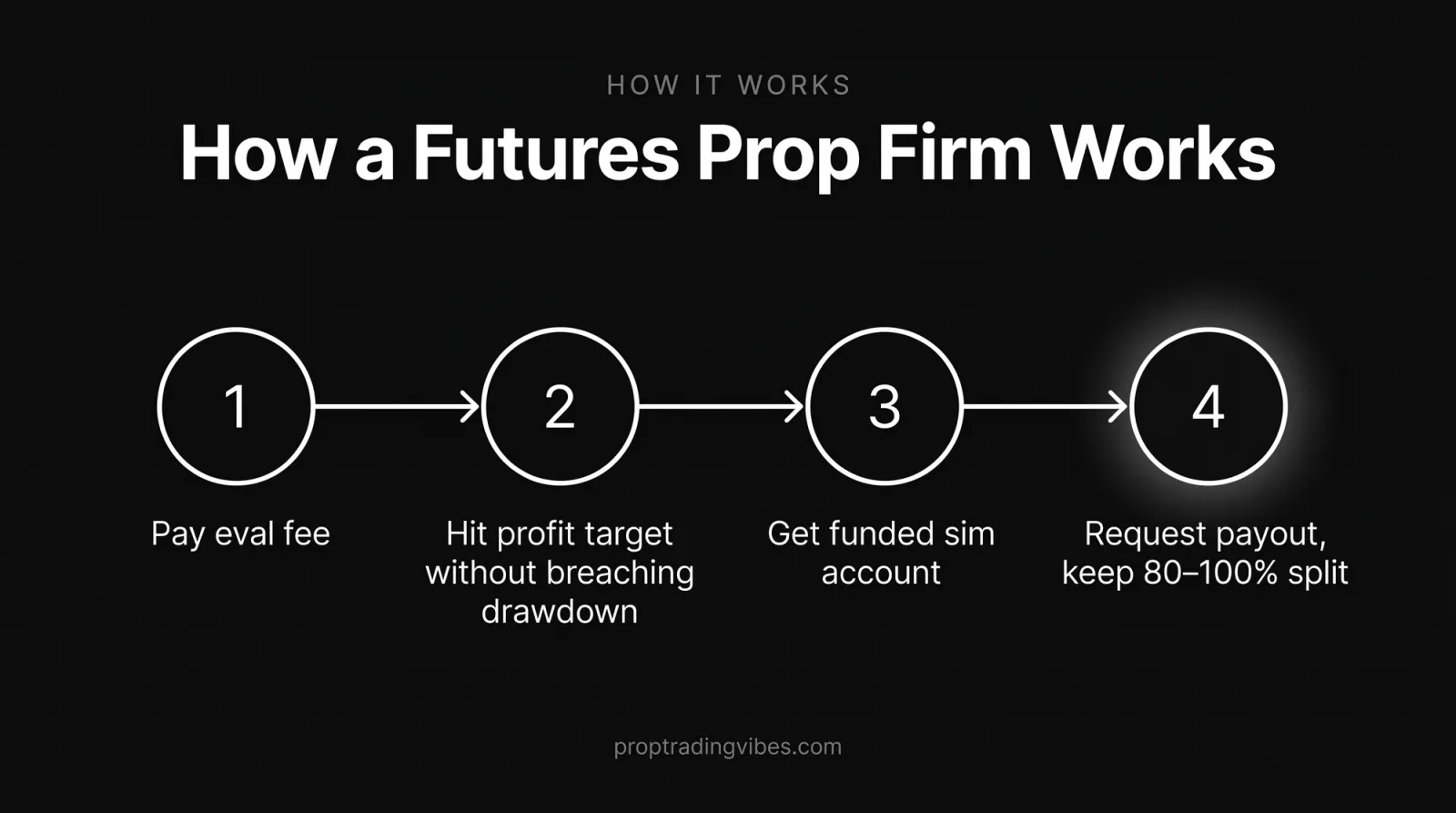
A futures prop firm sells access to an evaluation or a straight-to-funded program for trading futures contracts such as ES and NQ. Most retail programs begin in simulation, including the first funded stage. If you qualify for a payout, the firm pays under its agreement; a move to live capital is a separate decision. You still risk evaluation fees, resets and any other charges you agree to pay.
I use this guide to narrow the account choice before buying. Lucid is my number one for futures. The other firms below form a shortlist with different strengths and different amounts of first-hand evidence. A good experience with one account generation also needs to be checked against the rules being sold now.
The 50K account comparison takes its rules from the same Data Core records as the reviews. The rest of this guide explains why those differences change the choice. For score definitions, source checks and the limits of my testing, see the Proptradingvibes methodology. Affiliate links may earn a commission; a code or commission does not establish that an account suits your strategy.
What makes a futures prop firm worth using in 2026?
Start with the strategy you intend to trade after passing. Can it survive the funded drawdown? Can a normal sequence of profitable days qualify for a withdrawal? Is the platform available for that exact account? An evaluation discount cannot answer any of those questions.
The nominal balance can make two accounts look equivalent when their usable loss room is different. A 50K account with a $2,000 maximum loss does not give you $50,000 of risk capital. Its initial failure boundary is much closer. Your own risk per trade needs room for normal losing sequences, commissions and slippage within that limit.
The funded stage can then change the calculation. A program may use an end-of-day reference during the evaluation and an intraday reference after passing. Another may keep the drawdown method but introduce a payout buffer or a best-day percentage. Check both columns before deciding that an easy evaluation means a comfortable funded account.
These are the checks I would make before paying:
- Drawdown reference and enforcement. Find out when the threshold moves, whether open profit raises it, and whether an intraday equity dip can breach the account. An end-of-day calculation does not mean you can ignore the limit during the session.
- Withdrawal conditions. Read the qualifying-day count, best-day calculation, buffer and request cap together. Then check approval and transfer times separately. A daily request window says nothing by itself about when money reaches your bank.
- Platform and account fit. Confirm the supported connection for the selected product, the number of accounts allowed at each stage and any copier restrictions. A platform logo on the homepage does not establish access on every account.
This guide is futures-only. If you also trade forex or crypto, start from the broad prop firm comparison guide, then come back here for the futures-specific picks. For the full decision framework, see how to choose a prop firm and the breakdown of trailing drawdown explained.
What are the best futures prop trading firms right now?
Lucid is my first choice. Tradeify, Top One Futures and Funded Futures Family deserve space beside the longer-established names because they are part of my own futures trading experience. The comparison is intentionally account-specific: Growth is one Tradeify route, Velocity is one FFF route, and neither card stands in for the whole firm.
The source dates beside the cards refer to the displayed fields. They are not a new test of every account or a verification of a discount code. The review selectors cover other sizes, programs and options; check those if your intended purchase differs from the configuration shown here.
Why Lucid Trading is my first futures choice
My Lucid preference comes from trading LucidFlex and LucidPro and receiving 30+ payouts across those account generations. Approval has often been quick in my experience. I do not turn that experience into a universal claim that Lucid is faster than every competitor, or compare my approval time with another firm's minimum trading-day requirement.
LucidFlex is the starting point I would compare with an ordinary evaluation at another firm. The card above shows its evaluation and simulated funded stages with the daily-loss option switched off. The maximum loss still applies. If you choose the daily-loss option, another product, or a different account size, use the review selector so the displayed rules match it.
Flex and Pro need separate decisions. I have traded both, but their payout conditions should not be blended into one Lucid rule. A best-day condition can be present during evaluation and absent from the funded stage, or survive into payout eligibility on another product. Select the funded stage in the review to see which conditions apply to your account.
LucidDaily and LucidDirect are other routes, and LucidMaxx has its own access conditions. My Flex and Pro payouts do not prove the experience on those accounts. If daily eligibility is the reason you are considering Daily, read the LucidDaily account breakdown and compare the funded drawdown before paying.
My experience and the account history are in the Lucid Trading review. I would still keep a personal daily stop inside the firm limit and treat each payout as a change to the remaining account cushion. Successful past withdrawals do not guarantee the next one or make the account disposable.
Tradeify: my tested Futures alternative
I have tested Tradeify’s Futures account types, passed numerous challenges and received 23 payouts. I currently have three funded 50K Growth accounts. Communication and the trading technology have been strong parts of my experience, which is why I include Tradeify among the firms I would compare with Lucid.
The Growth 50K card above reflects one path. Select and Lightning need their own checks. Lightning’s straight-to-funded access changes the purchase decision, but it does not remove trading limits or make every payout immediate. If you prefer an evaluation, compare the funded consistency and qualifying-day requirements as carefully as the pass conditions.
My direct experience is Futures only. Tradeify 247 and FX sit under the same brand, but I have not tested them yet. Their availability and account rules should be assessed within the Tradeify review using the product selector. The Futures payouts are not evidence that I have withdrawn from either of those other products.
Top One Futures: choose the payout path first
Top One Futures is another firm I have traded and include among my futures preferences. Its account menu needs more explanation than one overall payout-frequency label. The Top One Futures review separates Elite Daily, Elite Access, Instant and Ignite, with the relevant stages underneath.
The card uses Elite Daily 50K and its first simulated funded payout. Later requests and a move toward live capital can carry different conditions. If the account is attractive because it advertises frequent requests, check what happens after a withdrawal and whether the remaining balance gives your strategy enough room.
Instant and Ignite should be compared as their own purchase paths, not substituted into the Elite Daily card. A trader looking for immediate access is making a different cost and risk choice from someone willing to pass an evaluation. Keep that distinction visible when comparing Top One with Lucid or Tradeify.
Funded Futures Family: 12 payouts, with configuration-specific rules
I have traded Funded Futures Family since early 2025 and received 12 payouts across 2025 and 2026. My experience has been positive. That gives FFF a place in my shortlist on first-hand grounds, without relying on a company-wide payout total or somebody else’s review score.
Velocity, Premier+, Prime and Straight to Funded are different account decisions. The FFF review carries those options. The comparison above selects Velocity 50K with its standard payout configuration; a daily-payout option must not silently inherit the standard configuration’s conditions.
For that reason I would compare the fresh-profit requirement, qualifying days and best-day calculation together. A program can offer a short request cycle while still requiring a meaningful profit target before the request. My 12 payouts show that I have completed withdrawals; they do not mean every new account is eligible on the same schedule or on the same terms I traded previously.
When Apex or Topstep belongs on the shortlist
Apex and Topstep deserve a comparison when your decision turns on multi-account operation, platform workflow or the route after evaluation. Neither should hold a high position in a list merely because it is familiar. Compare the current product you can buy with the product in the review, especially if an older trader's experience describes a previous rule set.
Topstep has separate purchase paths and Express Funded payout paths. The comparison above uses the Standard purchase path and Standard Express Funded path; it is not the Consistency path or a Live Funded Account. The evaluation fee, any activation fee and the funded payout conditions need to be considered together. TopstepX is also part of the choice: confirm that the available workflow suits your charts, execution and account management before treating onboarding familiarity as an advantage.
Apex Trader Funding has EOD and Intraday paths, with purchase options that affect the activation cost. The card uses the current EOD Standard 50K path, the Rithmic/WealthCharts evaluation configuration and the first Performance Account payout. It is not a summary of legacy Apex accounts. If you plan to run several accounts, check the current account limit and copier permissions, then calculate the fees and risk across the whole set. Multiplying an account label does not create an equivalent amount of withdrawable capital.
The Lucid, Apex and Topstep comparison covers that narrower choice. Read it when those are your final candidates; the individual reviews are the source for current account selections.
FTMO Futures: separate the product from my CFD experience
FTMO Futures remains a research-only entry here. My FTMO CFD experience is relevant to why I follow the operator, but it cannot demonstrate the Futures product's order handling, funded transition or withdrawal process. It should not inherit a tested Futures badge or an automatic place above firms from which I have received futures payouts.
If you are considering Growth or Pro, compare those specific Futures paths. Do not carry a CFD rule, platform assumption or payout experience into the Futures decision. An established brand can launch a new product with a different contract, workflow and risk model.
The FTMO review and Futures selector keep the product distinction visible. I have not personally traded or withdrawn from FTMO Futures. Until that changes, my comments on its rules remain research, with the source and account scope doing the work.
Which futures prop firms are best for funded-account flexibility?
MyFundedFutures and TradeDay illustrate why a firm-wide rule label is too broad. Both offer more than one route. A claim such as 'no funded consistency rule' needs a program and stage attached to it before it helps you choose.
The MyFundedFutures review separates Rapid, Rapid EOD, Builder and Pro. The card in this guide uses Rapid 50K. Its evaluation and simulated funded drawdown differ, so an evaluation result does not by itself show that the same approach will survive after passing. Start with the funded column, then read the buffer and request conditions. If you want another drawdown model, compare Rapid EOD rather than assuming the Rapid name covers both.
TradeDay also needs a funded-stage check. The Quick Pay EOD path shown here uses an end-of-day evaluation reference, then moves to intraday trailing in Funded Sim. Fast Pass is a separate comparison. I have traded TradeDay since December 2024 and reported three funded 50K accounts; that experience does not remove the need to identify the exact program and cohort in front of you.
For the format-specific picks, see best prop firms for day trading and best prop firms for swing trading.
What is the catch with cheaper futures prop firms?
A cheap evaluation can become expensive through renewals, resets, activation fees or repeated failed attempts. A payout condition can also postpone a request even when the trading account is profitable. Those are different outcomes: an ineligible withdrawal is not automatically a breached account or a refusal to pay an eligible request.
Bulenox is a useful example of why to separate Qualification, Master and a possible later Funded transition. I have tested both options and multiple sizes, and my payout requests cleared. That supports my account experience. For a new purchase, the Master payout conditions still need to be checked against the current record rather than a general claim that the firm pays.
Model your best realistic day against the selected account's best-day rule before buying. If an otherwise ordinary profitable week would leave you ineligible, choose another program or accept that the request may take longer. Do not manufacture extra trades solely to dilute a percentage, and do not count a payout before all of its conditions are satisfied.
How should you pick your first futures prop firm?
Pick a setup you can trade consistently within the funded rules. Start with maximum loss and its calculation, check the payout requirements, then the platform and total cost. A discount is useful only after the account passes those checks.
Replay ordinary winning and losing sessions against the rule. With intraday trailing, open profit may raise the threshold before you close a position. With an end-of-day reference, the threshold can still be enforced during the session. A strategy that often gives back open profit needs to account for that difference; the label 'EOD' does not make it immune to a breach.
Next confirm the trading connection at checkout. Check whether your preferred charts can place orders on the chosen account, whether an extra subscription is needed and whether the connection changes after funding. Save the selected account details so you can distinguish the terms you bought from a later program update.
Then calculate the expense if passing takes longer than expected. Separate the first charge from renewals, resets and activation. Allow for trading costs and data subscriptions where relevant. Decide in advance when you would stop buying attempts; a lower checkout price is not a reason to keep replacing an account without fixing the trading problem.
My choice and the check before checkout
Lucid remains my first futures choice because it has the strongest place in my own trading and payout history. I would put Tradeify, Top One Futures and Funded Futures Family into the comparison before treating the familiar Apex and Topstep names as automatic runners-up. The final account choice depends on the rules you will trade after passing.
Open the review for your intended account, select the program, size and funded stage, and compare it with the current checkout. If a source is unclear or the terms do not match, resolve that before paying. Current PTV codes and offers are a separate commercial check; a promotion does not validate the account rules.
Frequently Asked Questions
What is a futures prop trading firm?
A retail futures prop firm provides an evaluation or funded program for trading futures under a defined loss limit. Many funded accounts are simulated and pay eligible rewards under the firm's agreement. Live capital, where offered, is a separate stage. Fees and resets are still your expense.
Which futures prop firm pays out fastest?
I have had quick approvals at Lucid, but I do not have a controlled transfer-time test across every firm here. Compare when you can request a payout, how approval works and how long the selected payment method takes. A daily request window and a bank transfer completed in a day are different claims.
Which is the best futures prop firm for beginners?
Start with an account whose funded drawdown and payout conditions you can explain before trading. LucidFlex is my first comparison, while Topstep may suit a trader who wants its platform workflow. Neither is automatically easy: use the loss limit, fees and your own practice results to decide whether paying for an evaluation makes sense.
How much does a futures prop firm evaluation cost?
The cost depends on the exact program, size and billing path. Add the first payment, expected renewals, reset charges and any funded activation fee. Read an offer's scope separately: it may cover only the first purchase or selected programs, and a price check does not prove a promo code works.
What is the difference between EOD trailing and intraday trailing drawdown?
End-of-day trailing uses a session-end reference to update the threshold. Intraday trailing can follow peaks during the session, including open profit where the rule specifies equity. Both can be enforced while you trade. Read the exact calculation, lock point and funded-stage changes rather than relying on the label alone.
Do futures prop firms let you trade through the news?
News permissions depend on the program and stage. Check the relevant events, time window, whether holding and opening trades are treated differently, and what happens to a trade placed inside the window. Evaluation permission should not be assumed to carry into funded trading.
What is a consistency rule and which firms have one?
A best-day or consistency condition limits how much of the relevant total profit may come from one day. Some programs apply it to passing, others to payout eligibility, and some have none at the selected stage. Check whether the condition is a strict threshold and whether missing it postpones a request or breaches the account.
How many futures prop accounts can I run at once?
Check the selected firm's current limit at the evaluation, simulated funded and live stages. Account ownership, household rules and copier permissions can impose separate limits. Running more accounts also multiplies costs and correlated losses; the combined nominal balance is not your available loss budget.
Are futures prop firms legit?
Some firms deliver the accounts and payouts described in their agreements, and my reviews distinguish where I have personally traded and been paid. That does not make every operator reliable or turn a funded simulation into a brokerage account. Read the contract, current withdrawal conditions and evidence for the specific firm; a high rating alone cannot establish those facts.
Which futures prop firm has the best profit split?
Compare the split on the exact funded stage together with the request cap, buffer and qualifying conditions. A higher percentage is less useful if you cannot make an eligible request under your normal trading results. Do not apply a legacy bonus or a live-capital split to a newly purchased simulated account.
What platforms do futures prop firms support?
Platform support depends on the firm, product and connection. Check the chosen account in the review and at checkout, including any charting subscription or data cost. A brand-wide list does not guarantee that every listed platform works with every program or after a live transition.
Can I get a futures prop account with instant funding?
Yes. Routes such as LucidDirect and Tradeify Lightning skip the evaluation. Straight-to-funded still has loss limits and payout conditions, and the account may be simulated. Compare those requirements with the evaluation route rather than treating instant access as an easier withdrawal.
The bottom line
Lucid is my first futures pick. Compare tested alternatives by exact 50K evaluation and funded rules, with source dates and clear experience boundaries.

Where to go next
The most useful next decision from this page.